- Location Strategy Chartbook
- Posts
- Location Strategy Chartbook 02.21.2026
Location Strategy Chartbook 02.21.2026
Real Estate Market Insights
A cooler-than-expected consumer price index (CPI) report offered markets a welcome surprise last week.
Continued softening in housing costs, lower energy prices and a temporary drop in used-car prices led to a 0.2% monthly increase in January price levels, bringing the annual reading down to 2.4% from 2.7% in December.
Core inflation, which excludes the more volatile energy and food categories, fell to 2.5%, its lowest annual reading since March 2021. However, the monthly increase in core prices rose 0.3%, up from December’s 0.2% growth.


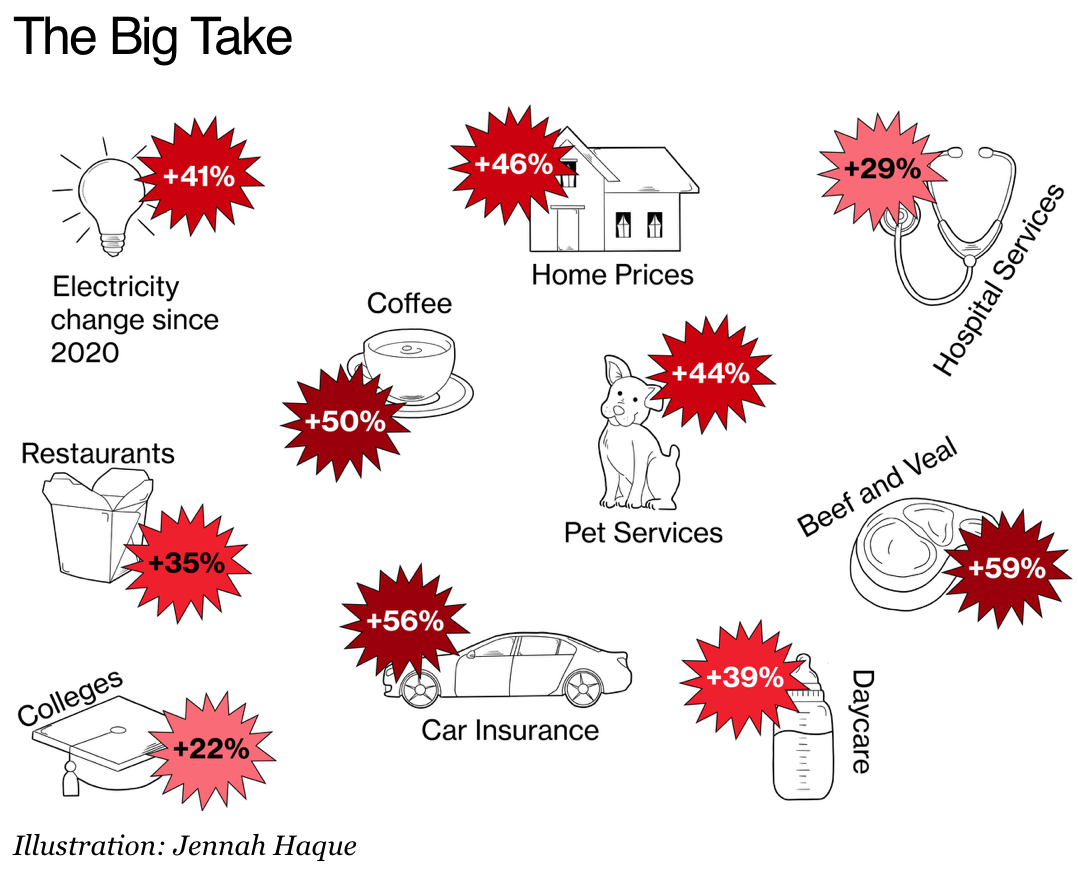
Bloomberg: Inflation may be down but, with grocery and electricity prices already at records, Americans aren’t feeling relief. Consumers now dole out $126 for what cost $100 before the pandemic, leaving many feeling they’re treading water rather than getting ahead.
The Supreme Court decision reverberated across the $30 trillion US bond market by threatening to increase the government’s budget deficit and do more damage to an economy already contending with elevated inflation and unemployment.
While Trump said he would approve a new 10% global tariff in place of the ones he just lost, the long-term outlook still remained unclear, given that the provisions of the law he invoked involve temporary duties.
“It’s a short-term vehicle,” said Gregory Faranello, head of US rates trading and strategy for AmeriVet Securities. “The devil will be in the details with various trade deals to date.”

WSJ: Demographics, rising profits and soaring asset values have together wrought a quiet transformation in the American economy. Much of it is now in the hands of the elderly.
As of the third quarter of last year, people 70 and over controlled roughly 39% of all equities and mutual funds owned by households, compared with 22% in 2007, according to Federal Reserve data. Their share of net worth—assets minus debts—was 32%, up from 20% two decades earlier.


Online shopping may be AI’s next victim. In the age of agentic commerce, autonomous chatbots will select and buy goods for us—potentially rewiring digital retail.

The latest batch of estimates from the Census Bureau have reaffirmed Texas’ status as the nation’s leading state for population growth.
According to the bureau’s most recent release, the Lone Star State saw the largest nominal gains in the country last year, adding 391,243 new residents between 2024 and 2025. With continued momentum well into the 2020s, the state’s population now exceeds 31 million.
Texas added nearly twice as many new residents as the second-ranked state for nominal growth, Florida. The Sunshine State has experienced considerable tailwinds for commercial real estate in recent years as a wave of retirees and other domestic and international migrants settled in growing cities such as Miami, Tampa and Orlando.
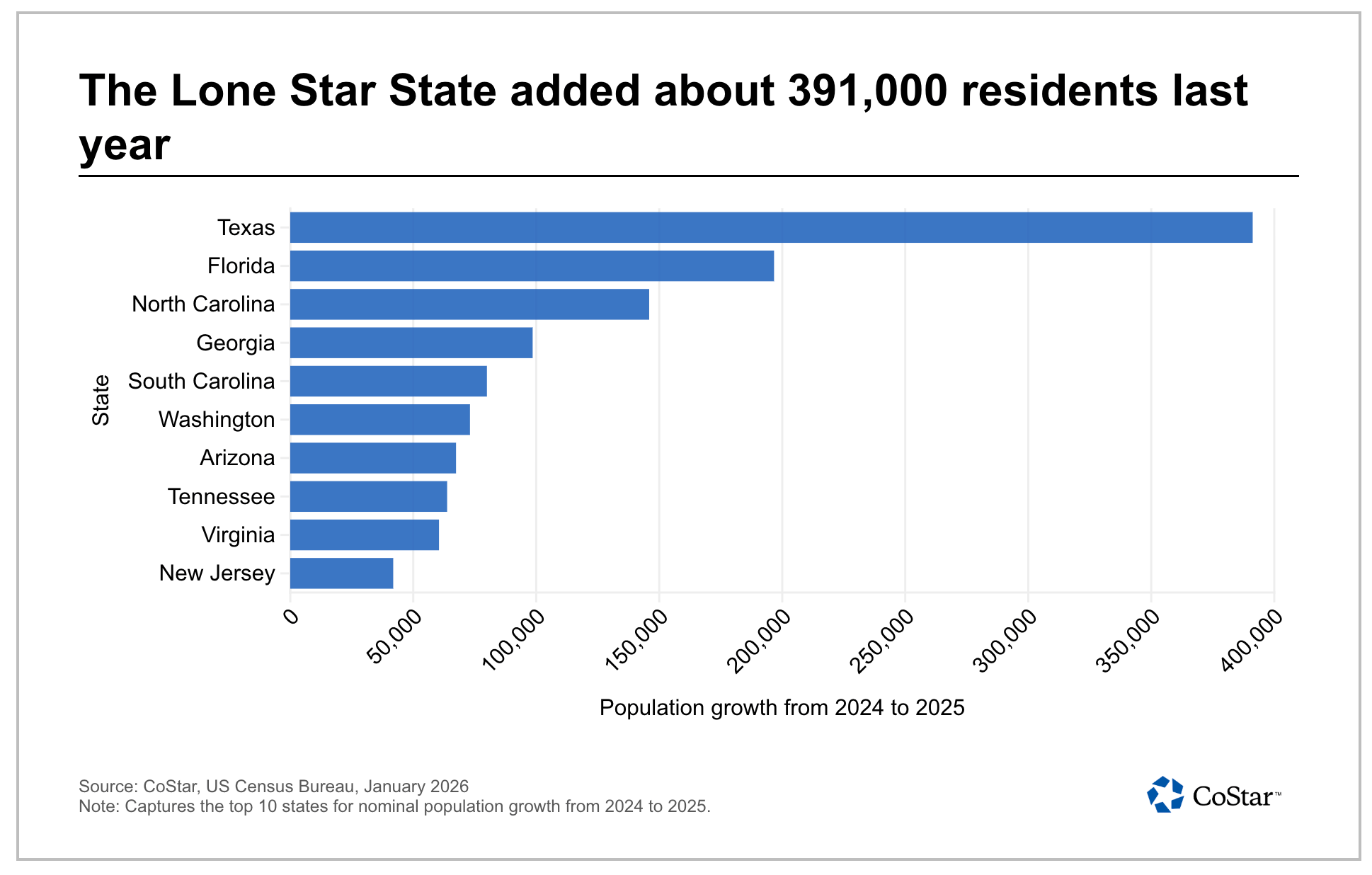
Outside of Texas and Florida, the South is well represented among the nation’s fastest growing states. North Carolina, Georgia and South Carolina have also attracted a significant number of new residents to their metropolitan areas over the past five years.
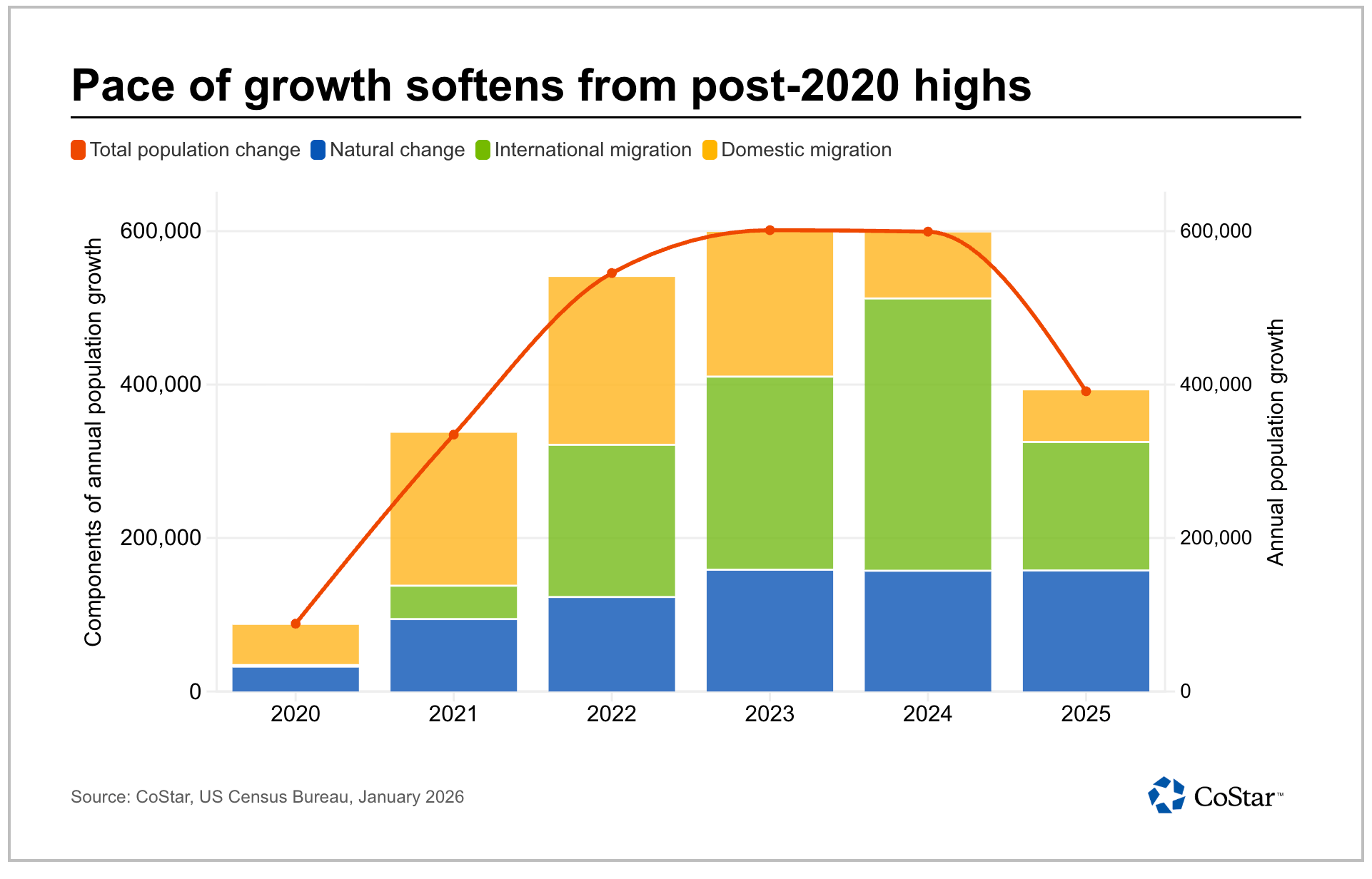
International migration has halved over the past year, undercutting one of the largest sources of population growth for Texas. Texas added 167,475 residents from other countries over the past year, second only to Florida. While this is considerable, many experts anticipate that this level will shrink further with a more restrictive policy environment for immigration over the next few years.
In terms of domestic in-migration, North Carolina was the only state to attract more Americans to its borders than Texas. North Carolina, as well as Colorado, is one of the few states that manages to consistently attract Texans year after year.
Vacancy drives concerns in Dallas: Kroll Bond Rating Agency has downgraded seven ratings in a $200.3 million CMBS deal, citing rising losses from troubled office properties, including 2100 Ross Ave. in downtown Dallas.
The downgrades affect MSCI 2016-UBS9, part of a financing package now backed by seven assets.
The 2100 Ross office tower drove much of the concern. The 879,458-square-foot, Class A building has seen its occupancy plunge from 85.7% when the debt was issued to 64.3%, according to KBRA.
CBRE, the property's largest tenant, vacated in March 2022 after its lease expired. The real estate services firm had accounted for 20% of base rent at KBRA's 2022 review.
Leases generating 21.4% of base rent expire in 2026. Another 17.1% comes due in 2027.
The loan transferred to special servicing in November after the borrower defaulted on its balloon payment. The debt matured this month with an outstanding balance of $79.9 million.
KBRA estimated a $235,676 loss on the loan, reflecting a 0.5% loss severity. The firm valued the 33-story property at $79.5 million.
The special servicer reported the building is in good condition with no deferred maintenance.
CoStar data shows 225,640 square feet available for lease at 2100 Ross, a 27% availability rate.

U.S. existing home sales totaled 223K in January 2026
That's the lowest January existing sales volumes since 2009
Turnover remains strained in the existing-home market


Home prices are still climbing a little year-over-year in many regions where active inventory remains well below pre-pandemic 2019 levels, such as pockets of the Northeast and Midwest. In contrast, some pockets in states like Texas, Florida, and Colorado—where active inventory exceeds pre-pandemic 2019 levels by a solid clip—are seeing modest home price pullbacks or flat pricing.
