- Location Strategy Chartbook
- Posts
- Location Strategy Chartbook 03.07.2026
Location Strategy Chartbook 03.07.2026
Real Estate Market Insights
Trump’s war on Iran has traders staring down an energy crisis. While a limited surge in oil prices signals that traders are betting on a short conflict, a lengthy disruption threatens to cause chaos across markets.

By the fifth day of the US-Israeli war with Iran, shipping has effectively stopped in the crucial channel. And less than a day after President Donald Trump spoke of escorting and insuring shipping through the Strait, a container vessel there was attacked and disabled. It now floats abandoned in the waterway.

“History suggests that oil price spikes driven by geopolitical shocks can be short-lived if markets gain confidence that supply disruptions will be temporary,” they write in a report.
Goldman Sachs Rindels and Mei estimate that each $10 per barrel increase in oil prices would reduce US economic growth this year by about 0.1 percentage point (on a fourth-quarter over fourth-quarter basis) if prices stabilize at a higher level. Higher oil prices weigh on households’ disposable income, which in turn limits their spending.
Goldman Sachs Research finds that a sustained 10% increase in oil prices boosts US headline Consumer Price Index (CPI) inflation by 28 basis points. If oil prices increase by $10 and remain elevated for three months, Rindels and Mei write, US year-over-year headline CPI inflation would likely rise from 2.4% in January to 3% in May.


The US economic picture got darker on Friday. Unemployment rose back to 4.4% after grim February numbers and downward revisions painted a less-than-pleasant picture of America’s labor market. Nonfarm payrolls fell 92,000 last month, one of the largest declines since the pandemic, after a strong start to the year, according to the Trump administration. While some of the downside was expected in advance, a wide array of industries cut jobs in the month.
The figures call into question whether the labor market is actually steadying—as Wall Street economists and Federal Reserve officials had hoped—after the worst year for hiring outside of a recession in decades.
“The idea the labor market has turned a corner implodes with this report,” said Samuel Tombs, chief US economist at Pantheon Macroeconomics.

Private sector overall: -86,000
Hospitality -27,000
Healthcare -28,000
Manufacturing -12,000
Tranport/warehouse -11,000
Construction -11,000
Information -11,000
Federal gov't -10,000
Professional/biz -5,000
Mining -2,000
Social assistance +9,000
Finance +10,000


Treasuries are heading for their biggest weekly loss since April 2025 as surging oil prices fuel inflation concerns, overshadowing a surprisingly weak US jobs report that might otherwise bolster the case for Federal Reserve interest-rate cuts.

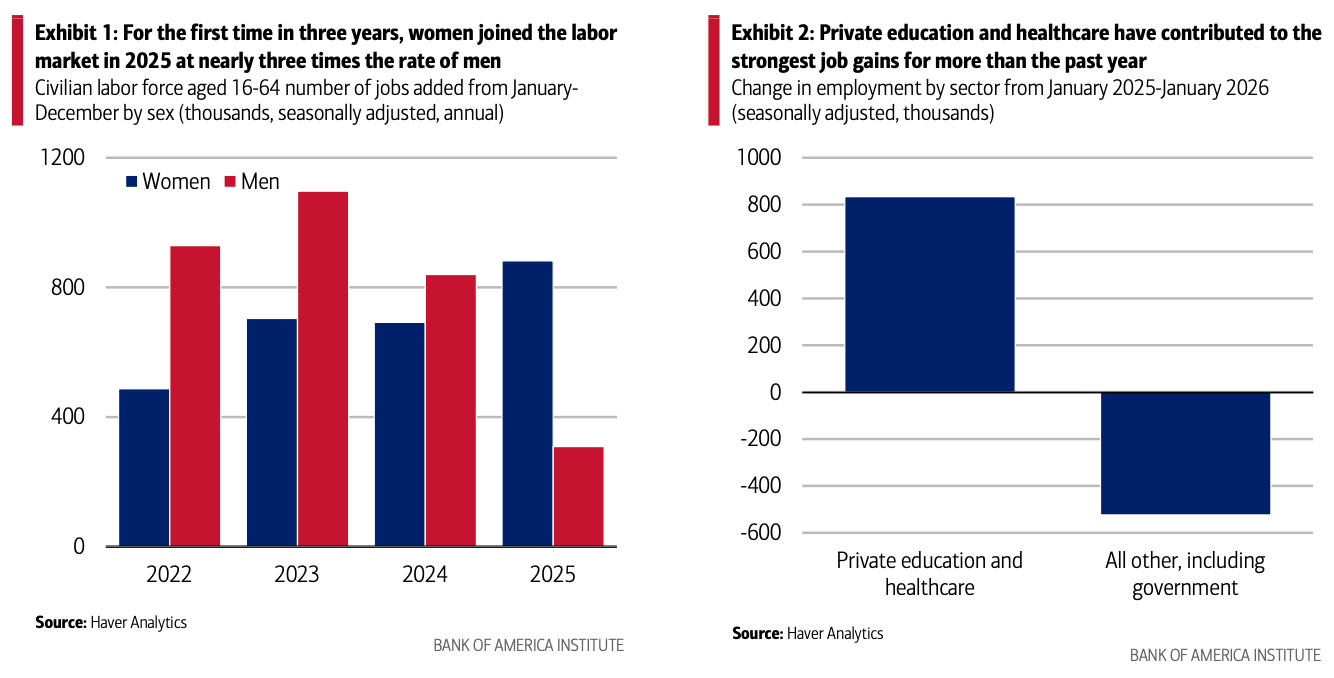
Women drove much of the labor force expansion in 2025, as hiring persisted in female-dominated sectors like private education and healthcare. This places women at the center of current labor market strength.
For both men and women, the rate of after-tax pay increases – whether tied to staying in a job or switching roles – has moderated meaningfully compared to last year
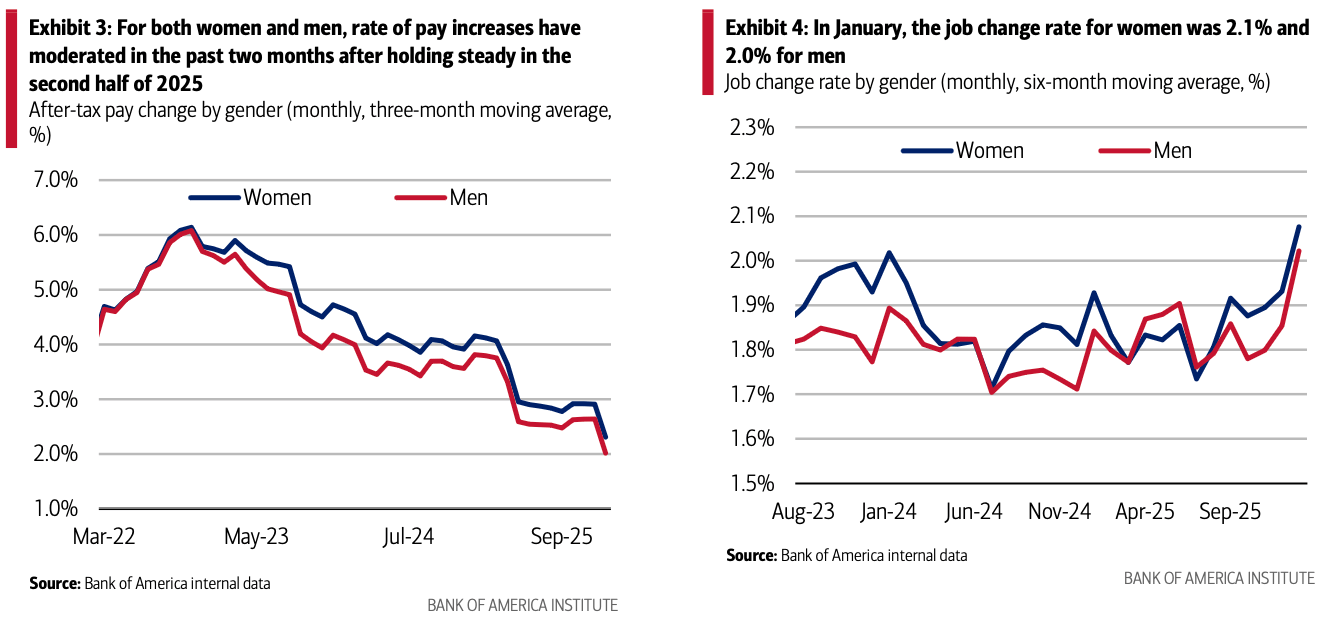

Women prioritize stretching their dollars

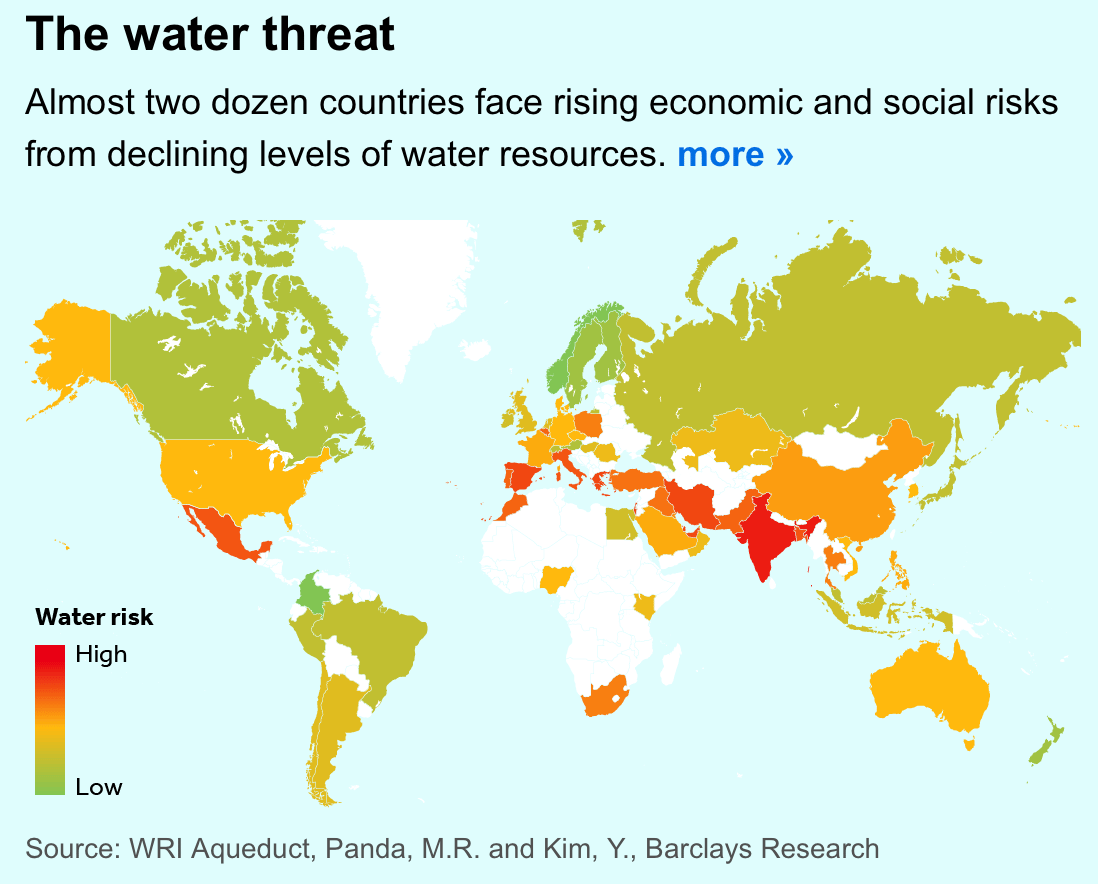
From a macroeconomic perspective, rising water risks can restrain industrial output and thus economic growth in some countries, especially as water demand increases and non-renewable supplies are depleted. Adaptation can be costly and difficult for countries without the budgetary resources to easily afford desalination projects. Companies operating in these countries or industrial regions can face increased costs to secure water as well.

Nationally, multifamily completions are projected to decline roughly 36% this year to about 333,000 units, a decisive shift away from the pandemic‑era construction surge.

"It's clear now that we expanded too quickly, and these closures are a direct correction," Potter said.
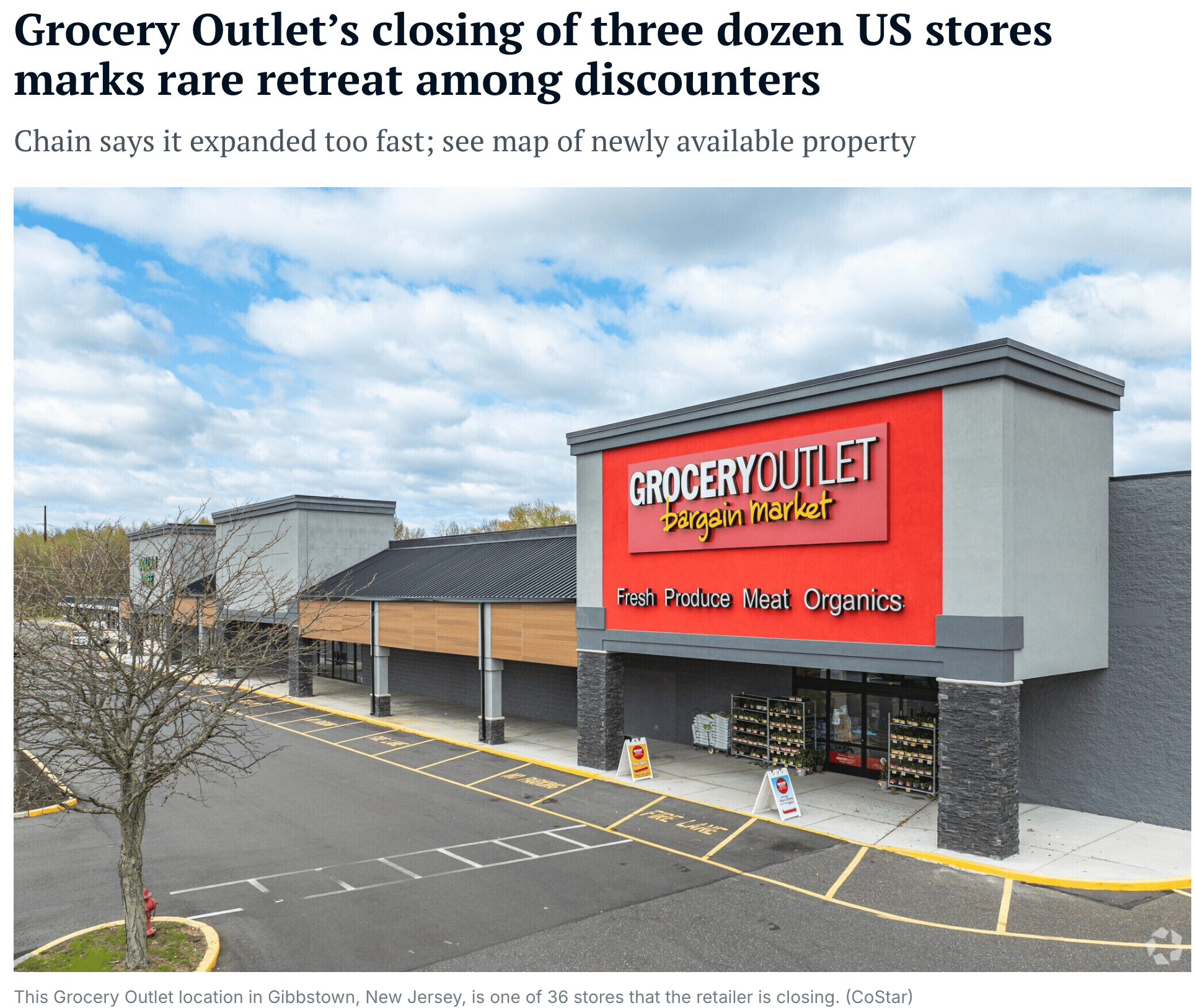
In the first quarter of fiscal 2026, the grocery chain said it conducted a strategic, financial and operational analysis of its fleet. On Monday, Grocery Outlet's board approved an optimization plan that calls for closing 36 financially underperforming stores.
The stores that will be closed didn't have "a viable path to sustain profitability," Potter said on the earnings call.
About 30% of them, 24 stores, are in the eastern region, with the 51 remaining there being profitable, according to the CEO. Grocery Outlet doesn't plan to abandon that area, Potter said.
The closing list contains locations in California, Idaho, Maryland, New Jersey, Ohio and Pennsylvania. They are already being marketed by Boston-based Gordon Brothers. The optimization plan is expected to be completed during fiscal 2026.
After taking a big macro hit during the 2022 rate-shock, United Wholesale Mortgage’s refinance volume has found its footing—and keeps climbing:
387% increase in UWM’s refi volume since its 2023 cycle low.

The number of actively listed homes rose 7.9% compared to February 2025, marking the 28th consecutive month of year-on-year inventory gains. On a monthly basis, inventory ticked up 0.2% since January (a typical seasonal pattern). Although listings are up again year on year, the pace of that growth has slowed in each of the past nine months (down from 31.9% YoY growth in May). As a result, the national inventory recovery continues to stall out. Specifically, nationwide February inventory is 16.8% below typical 2017–19 levels, about the same as last month.
Four metros now have over 50% more homes on the market than pre-pandemic norms: Denver (+81.9%), San Antonio (+69.4%), Seattle (+66.7%), and Austin, TX (+52.2%). At the other end of the spectrum, seven metros remain over 50% below 2017–19 inventory levels, including Hartford (-82.1%) and Providence (-61.1%).
