- Location Strategy Chartbook
- Posts
- Location Strategy Chartbook 07.26.25
Location Strategy Chartbook 07.26.25
Real Estate Market Insights
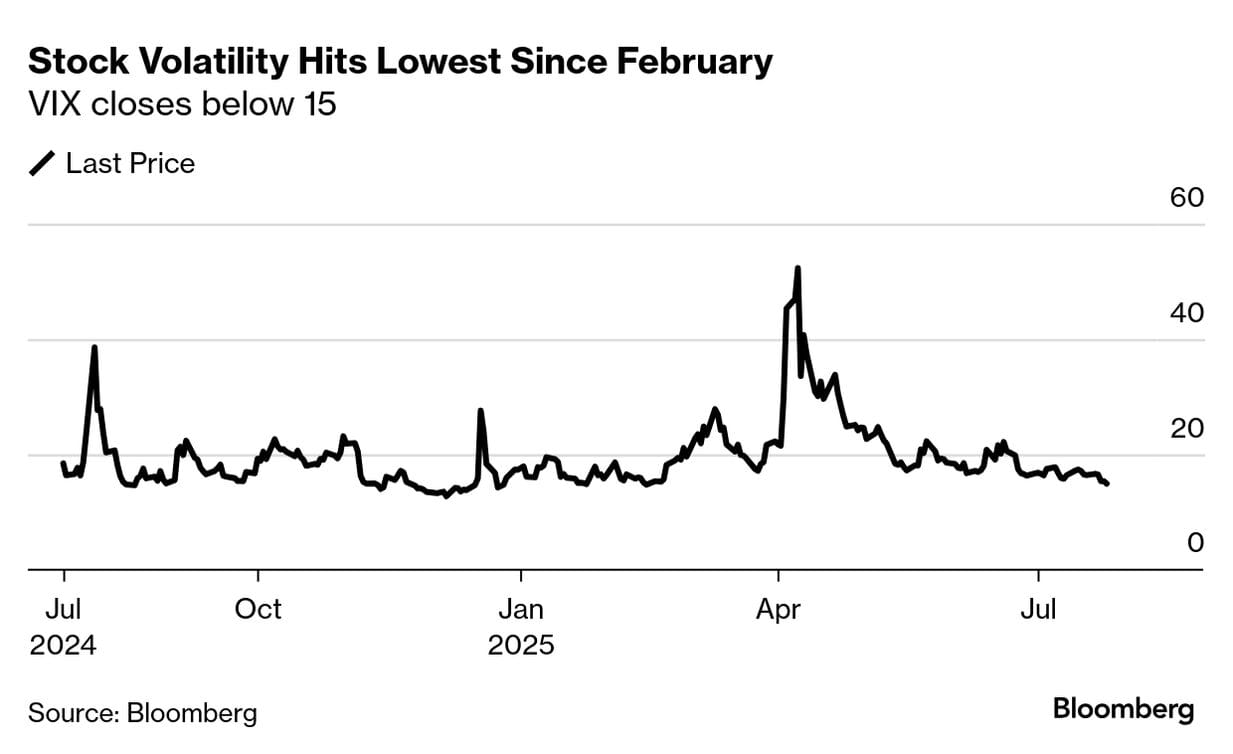
Wall Street ended the week on a positive note, with stocks hitting fresh all-time highs. In the run-up to the busiest week for corporate results, the S&P 500 rose for a fifth straight day, approaching 6,400. More than 80% of the index’s companies have exceeded profit estimates, according to data compiled by Bloomberg Intelligence. That’s on track for the highest share of beats since 2021. “The pace of earnings so far this month has been positive, economic data has been hanging in there, and we’re even starting to get some sense of clarity on tariffs,” said Bespoke Investment Group. “You can’t fault investors for being optimistic.”
Investors are signaling growing confidence in US stocks, particularly the large technology companies known as the Magnificent 7, according to a survey of 800 institutional investors run by Goldman Sachs Global Banking & Markets.
Around 51% of respondents were bullish on the S&P 500 index of large US stocks, compared with only 32% who were bearish.
Expectations of interest rate cuts, optimism about artificial intelligence, and the perception that geopolitical risks are moderating could all be supporting US stocks, according to Global Banking & Markets' Oscar Ostlund, global head of content strategy, market analytics, and data science for Marquee, and Brian Garrett, who oversees equity execution for the cross-asset sales desk.
There are also signs that views among investors have become concentrated: The proportion of respondents expecting the dollar to weaken amid growing US fiscal concerns is near an all-time high.

The private asset industry has been laying the groundwork for Trump’s plan to open 401(k) plans to alternative assets, with firms such as KKR, Blackstone and Blue Owl Capital asking retirement plan managers a pointed question: Why should only the elite have access to this type of investment?
As the White House readies an executive order to offer legal cover for including alternative assets in 401(k) plans, the potential rewards—and the risks—are becoming clearer.
Supporters point to attractive returns while critics say alternative assets are too risky and poorly understood by the mom-and-pop brigade. But those concerns are unlikely to change the trajectory of the industry’s push to tap into the $12.5 trillion retirement savings pool.
A green light from Washington could deepen the rift between the industry’s dominant players and middle-market firms, giving alts with “brand names” a clear signal to compete aggressively. That could leave smaller players in the dust. It could also pave the way for crypto to enter the mainstream.

The Power Industry May Need More Than 750,000 New Workers by 2030. There's growing risk of a labor crunch in the power sectors in the US and Europe: A push to electrification, industrial activity, and the acceleration of development in the data center sector are sparking a generational growth in global power demand.
For power sectors to expand their base of renewables, they'll need more workers. Renewable sources of power are over 2.5 times more labor-intensive than fossil fuels on average across their lifecycle, from manufacturing through construction and installation to operations and maintenance.
Further labor demand will come from the transmission and distribution industries—especially since renewable energy sources are often located farther from the areas they serve.
To meet the 300 gigawatts of additional power generation capacity by 2030 expected in the US, Goldman Sachs Research estimates suggest that 207,000 additional electricity transmission and interconnection workers will be needed.
Manufacturing, construction, and operations of power technologies in the US will need another 300,000 jobs. In Europe, our analysts estimate that around 250,000 incremental jobs in power generation are required by 2030.
“This new labor demand comes within a backdrop of an already tight labor market, adding potential constraints to the rate at which power demand can grow,” writes Evan Tylenda, head of EMEA for GS SUSTAIN at Goldman Sachs Research.

WSJ: Banks Are Getting Pickier About Credit-Card Customers
Lenders opened fewer cards in the second quarter, earnings reports show. They raised qualification requirements for lower-end customers that tend to be at greater risk of missing payments. It was a different story for richer clients, who are increasingly propelling the U.S. economy.

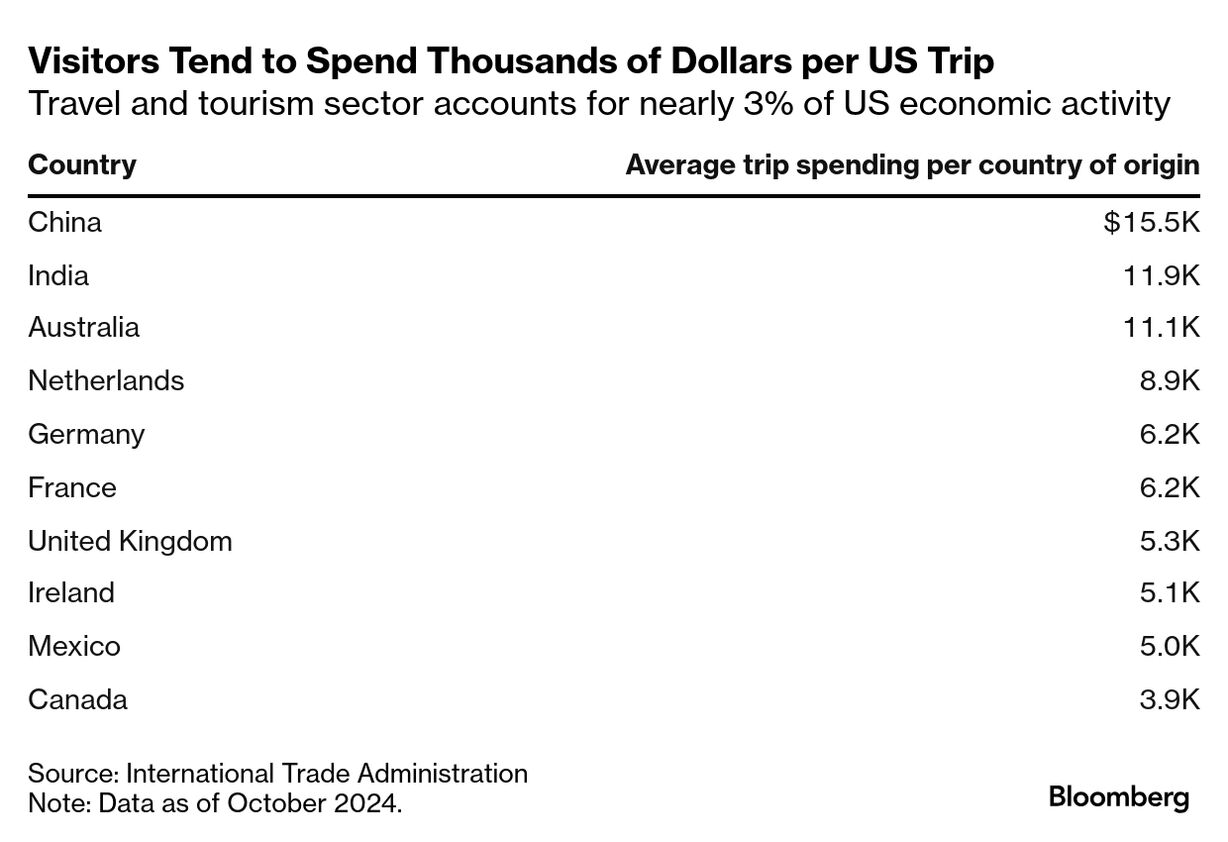
Shrinking tourism dollars. More than taking in views from the top of the Empire State Building or shaking hands with Mickey Mouse, visitors to the US come to do one thing: Shop. Not any more. We did the math and the trade war and border policies are putting almost $20 billion in tourism dollars at risk this year.
Barrett Linburg of Savoy Equity Partners: A hidden fire‑safety rule is quietly adding $1+ million to the price of many new apartment buildings. Crazy part? The gear it mandates has been used exactly once in a real US fire.
What is FARS? Imagine a gas pump on every floor. Firefighters plug empty air tanks into the wall, refill in two minutes, and keep going.
A 2023 NFPA survey of 200 fire departments found one confirmed activation: a 2021 apartment fire in Frisco, TX. No documented life‑saves.All other FARS activations have been drills and marketing claims.
The 2021 International Fire Code says buildings need FARS if they’re: 5 + stories above ground, 2 + stories below ground OR bigger than a 500 k sq‑ft
Cities adopted this edition in 2023‑24, so developers are just now finding out.
Johnson Controls owns the only code-approved FARS equipment after buying the patent holder in 2022. The International Code Council's voting structure only allows government code officials to vote on these rules—housing agencies, mayors, and affordability advocates get no voice.
Price list (per/building)
High‑pressure compressor $100 k
Storage tanks (cascade) $50 k
Blast‑rated pump room $350 k
Steel air pipes & fill panels $160 k
Street hook‑up $30 k
Total ≈ $650k ‑ $1M per building
What that means for rent
A 100‑unit building eats a $700 k bill. That’s $7 k per unit
Plus $5‑10 k a year in tests and tune‑ups.
Only projects that can command higher rents will get capitalized
Our next project in Dallas: 5 stories of apartments. Code forces FARS in 4 stairwells.. Bids came back $858 k ($215 k per stairwell) without the on‑site air‑supply gear (Dallas owns three air‑trucks already).
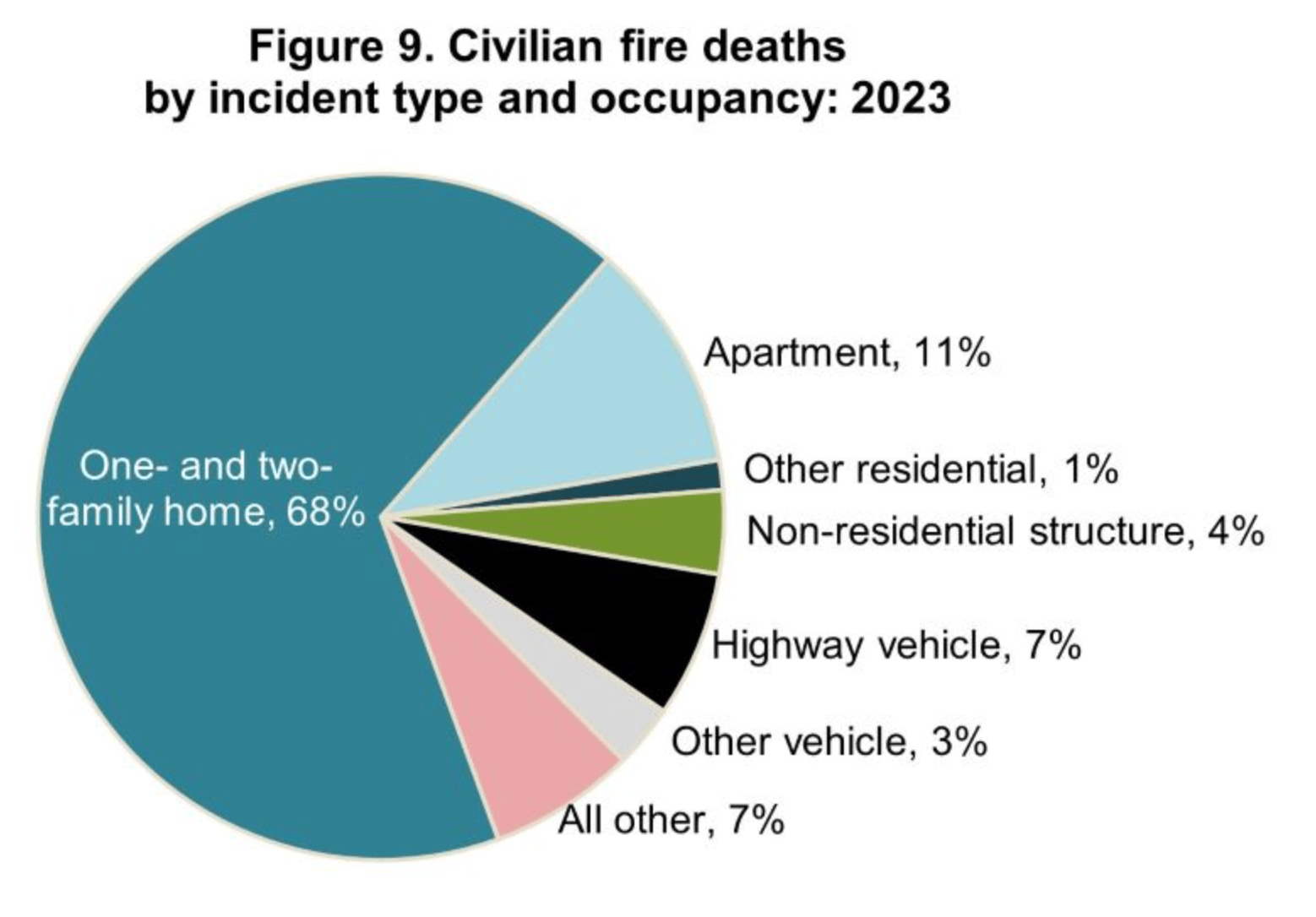
NFPA: In 2023, the 255,500 one- or two-family home structure fires (18 percent of the reported fires) caused 2,490 civilian fire deaths (68 percent); 7,450 civilian fire injuries (56 percent); and $8.7 billion in direct property damage (49 percent). From 2022 to 2023, fires in one- or two-family homes fell 9 percent, while deaths rose 11 percent, injuries rose 4 percent, and property damage rose 1 percent. The estimated number of structure fires in one- or two-family homes was 57 percent lower in 2023 than in 1980, while the estimated deaths and injuries were 40 and 54 percent lower, respectively. The decrease in the number of one- or two-family home structure fire incidents was statistically significant.
The 76,500 apartment or other multi-family housing fires in 2023 (6 percent of the reported fires) caused 400 civilian fire deaths (11 percent); 2,740 civilian fire injuries (21 percent); and $2.3 billion in direct property damage (13 percent). From 2022 to 2023, apartment fire deaths fell 15 percent, injuries fell 0.5 percent, and property damage increased 23 percent, due in part to several large loss fires.
The estimated number of apartment structure fires was 47 percent lower in 2023 than in 1980, while apartment fire deaths and apartment fire injuries were 61 percent and 24 percent lower, respectively. The number of injuries in apartments in 2023 continues an overall downward trend.
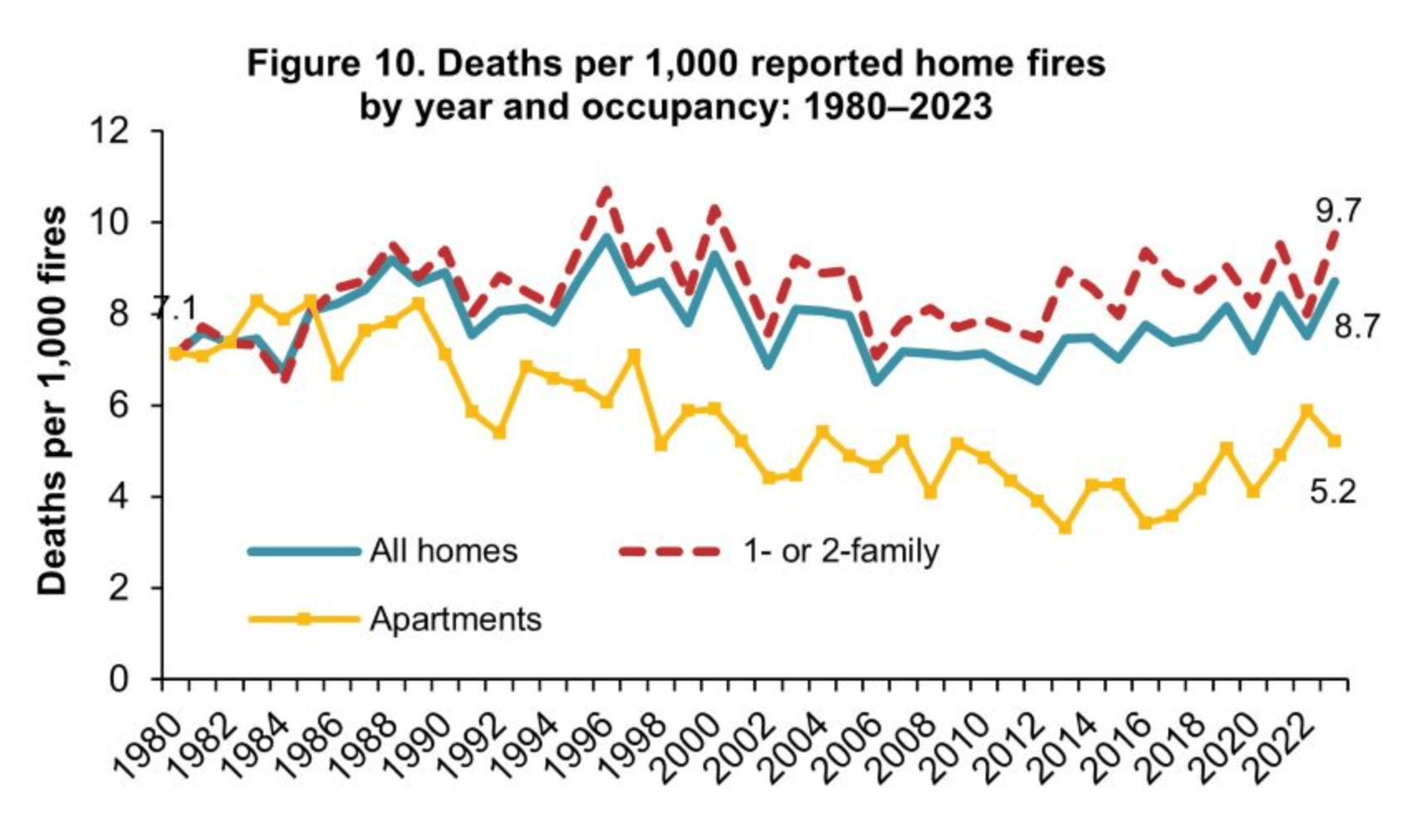
Less progress has been made in reducing death and injury rates in reported home fires. In 1980, there were 7.1 deaths per 1,000 reported home fires overall. This was also true for one- or two-family homes and apartments. In 2023, the rate of 8.7 deaths per 1,000 reported home fires was 23 percent higher. In comparison, the death rate per 1,000 reported apartment fires dropped 27 percent to 5.2.
Apartment buildings, particularly high-rise apartments, are more regulated than one- or two-family homes, where the 2023 rate of 9.7 deaths per 1,000 reported fires was 37 percent higher than in 1980. This is the highest rate of deaths per 1,000 one- or two-family home fires since 2000. While the rates fluctuated, 1984 was the only year in which the death rate (6.5) per 1,000 one- or two-family home fires was lower than in 1980. Apartment fire-based death rates have followed a consistent downward trend. However, the rates in 2019 and 2021 were the highest since 2010.
NFPA
NFPA

NFSA
On Tuesday, D.R. Horton—America’s most valuable and largest homebuilder, with a $46 billion market capitalization and ranked No. 123 on the Fortune 500—reported its third-quarter earnings for the three months ending June 30. While D.R. Horton’s earnings didn’t wow investors, the fact that there wasn’t an accelerated softening beyond what homebuilders—including D.R. Horton—had already reported earlier this year was enough for some Wall Street investors to buy back into homebuilder stocks.
D.R. Horton’s net new orders, by its fiscal Q3 (the three months ending June 30th)
Q3 2018 —> 14,650
Q3 2019 —> 15,588
Q3 2020 —> 21,519
Q3 2021 —> 17,952
Q3 2022 —> 16,693
Q3 2023 —> 22,879
Q3 2024 —> 23,001
Q3 2025 —> 23,071
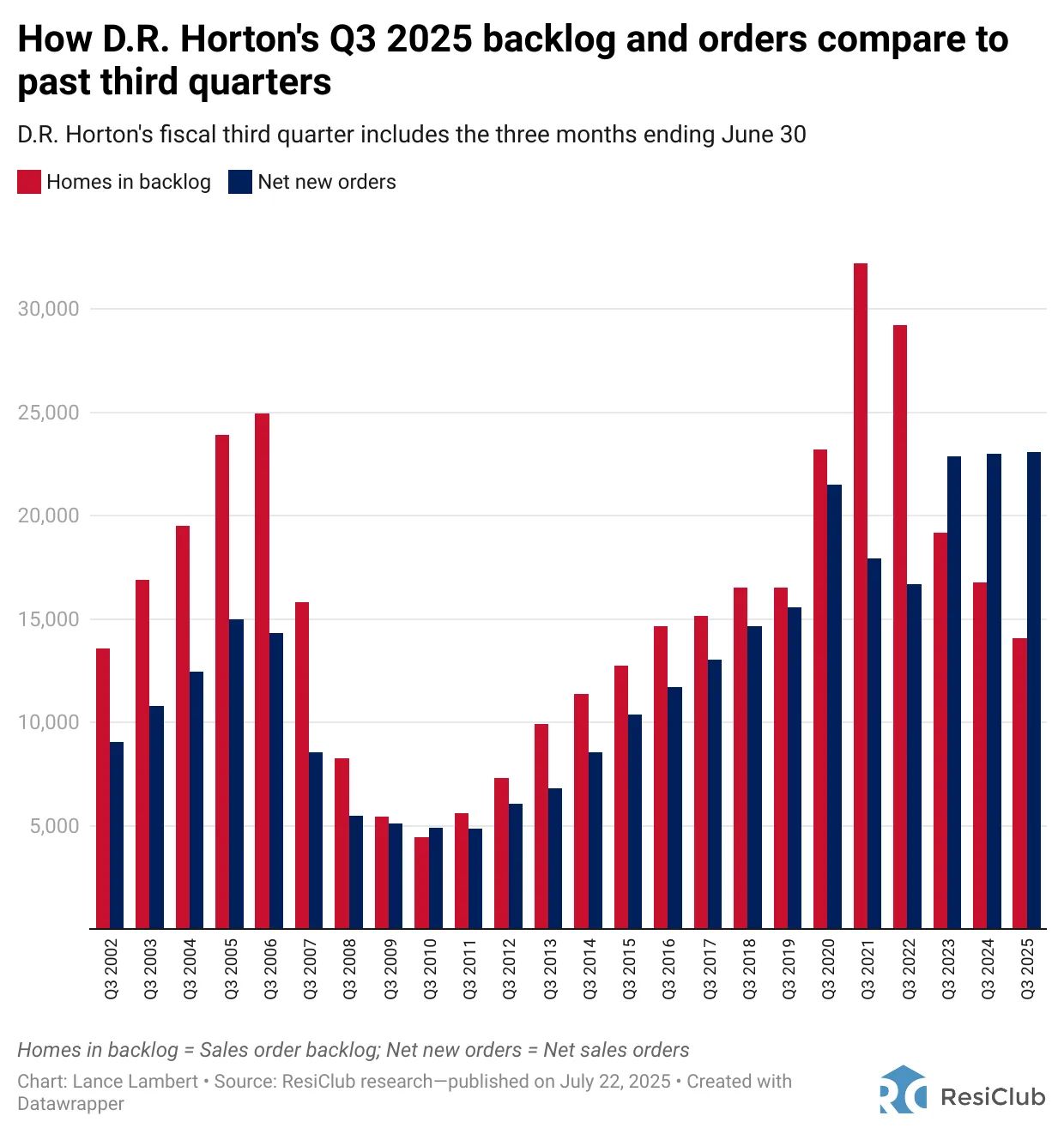
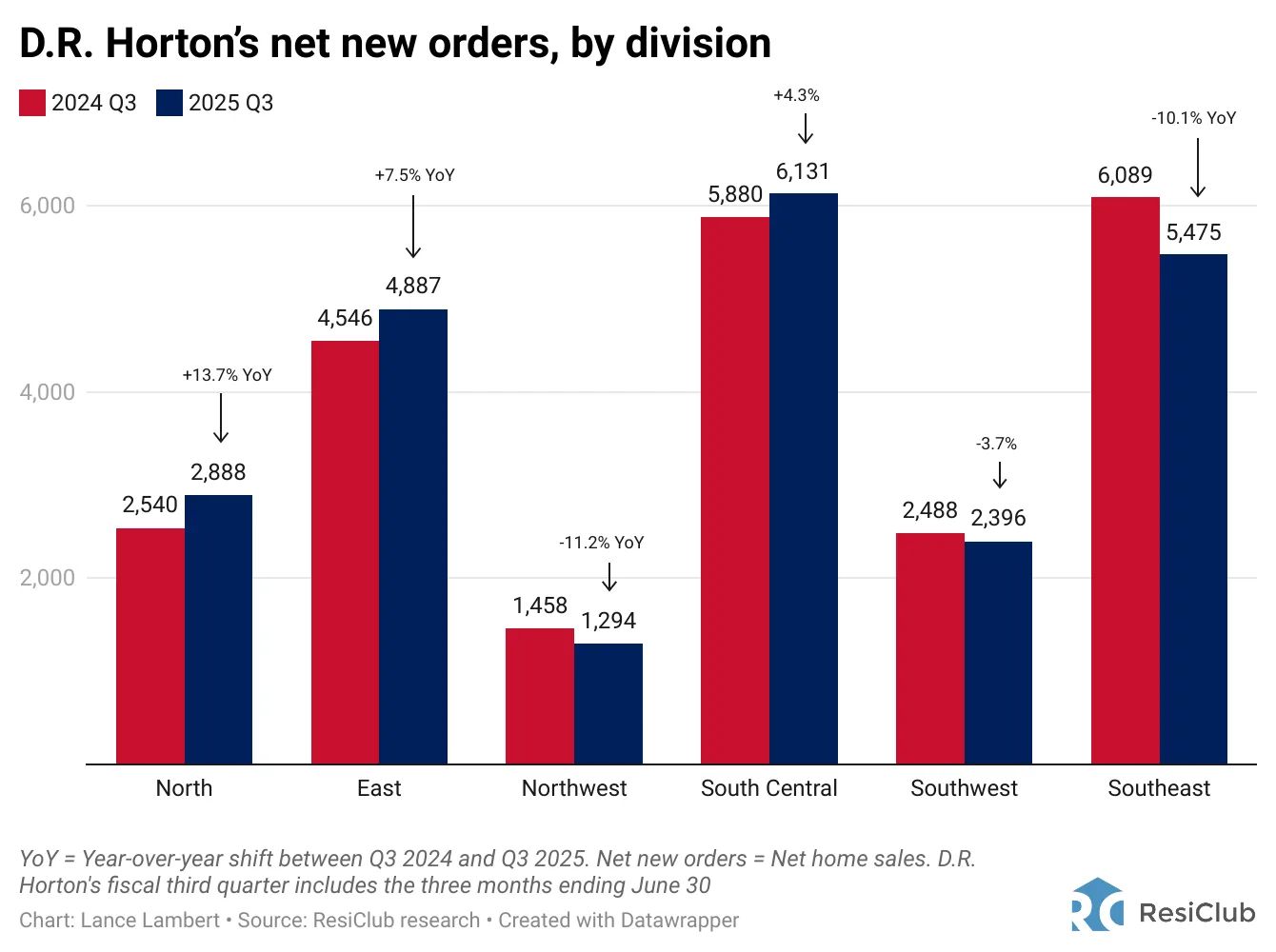
Wnet orders were pretty much flat year-over-year, there was a -10.1% year-over-year drop in its Southeast division. That division includes Florida—which D.R. Horton once again acknowledged remains on the softer/weaker side.
North (13% of D.R. Horton’s Q3 2025 net new orders): Delaware, Illinois, Indiana, Iowa, Kansas, Kentucky, Maryland, Minnesota, Missouri, Nebraska, New Jersey, Ohio, Pennsylvania, Virginia, West Virginia, and Wisconsin
East (21%): Georgia, North Carolina, South Carolina, and Tennessee
Northwest (6%): Colorado, Oregon, Utah, and Washington
South Central (27%): Arkansas, Oklahoma, and Texas
Southwest (10%): Arizona, California, Hawaii, Nevada, and New Mexico
Southeast (24%): Alabama, Florida, Louisiana, and Mississippi
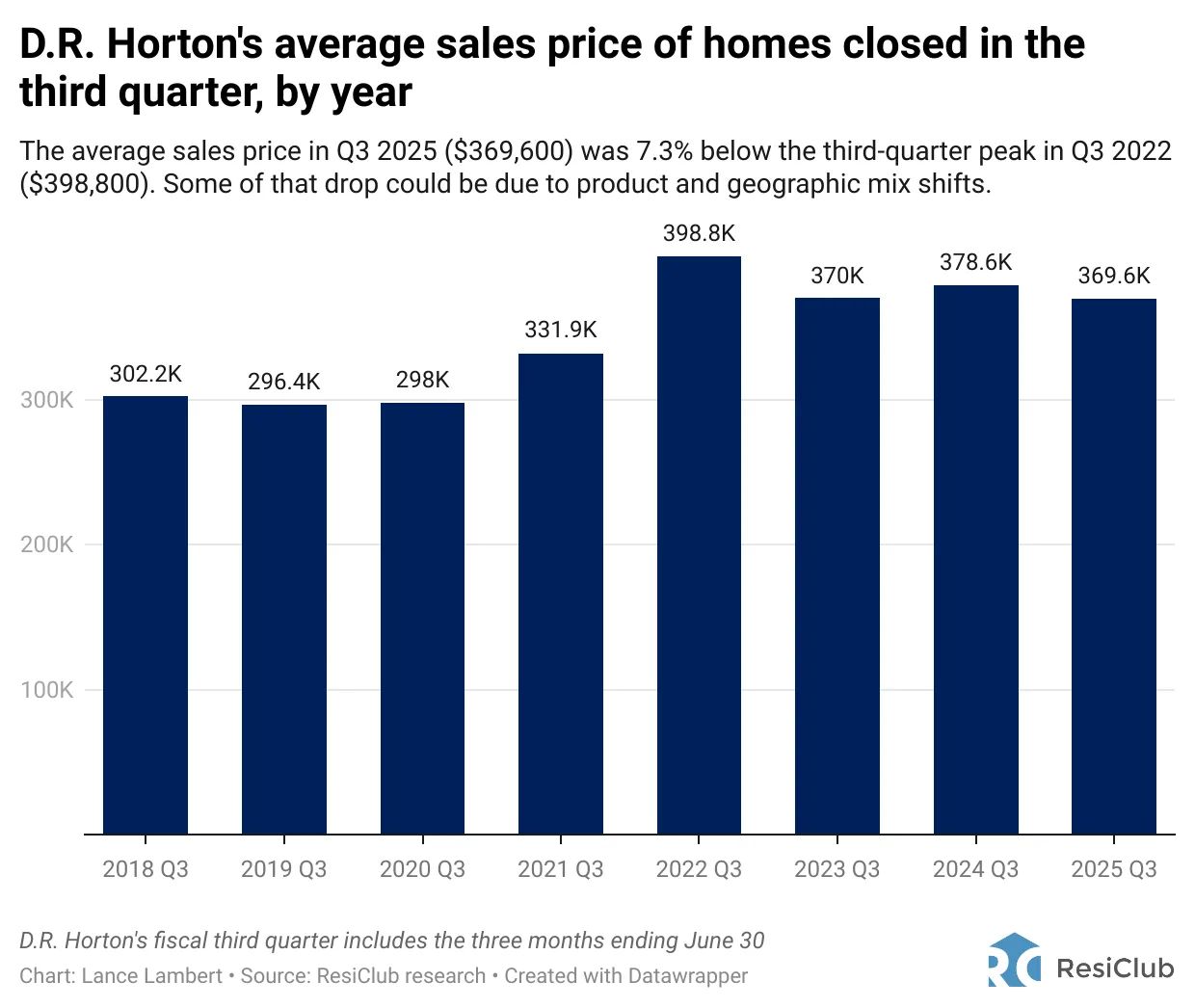

D.R. Horton reported a 21.8% gross margin on homes for Q3 2025. That’s down from 24.0% in Q3 2024; however, it’s unchanged from its Q2 2025 gross margin (21.8%). However, D.R. Horton acknowledged that, looking ahead, “the trend is still pointing towards a bit higher incentives.” On Tuesday, the company told investors it expects Q4 2025 margins to come in between 21.0% and 21.5%."

U.S. existing home sales totaled 391,000 in June 2025. That's -26% below pre-pandemic June 2019. U.S. existing home sales have been at historically low levels since late 2022. The seasonally adjusted annualized rate (SAAR) came in at 3.93 million for the June 2025 reading. That means IF we maintain the current pace, and seasonality acts as expected, we'd do 3.93 million U.S. existing home sales over the next 12 months.
