- Location Strategy Chartbook
- Posts
- Location Strategy Chartbook 11.22.2025
Location Strategy Chartbook 11.22.2025
Real Estate Market Insights
Happy Thanksgiving. I hope everyone enjoys time with family and friends next week celebrating blessings. We’ll be taking a break next week for the holiday.
US small business owners say inflation and access to capital are making operating conditions more difficult, but they remain upbeat about their growth prospects, according to a survey run by Goldman Sachs 10,000 Small Businesses Voices from September 23-October 2.
Amid rising prices and labor costs, 72% of the 1,471 small businesses surveyed say inflationary pressures increased over the past three months. Three-quarters of those who applied for a business loan or line of credit in the last year found it difficult to access affordable capital.
Despite these challenges, a solid majority of the respondents (78%) are optimistic about the trajectory of their business, and 74% have plans to grow their business in the next 12 months. Some 41% plan to create new jobs, slightly more than the 39% who plan to hold employment steady. And a large majority say that artificial intelligence is augmenting, not replacing, their workforces.

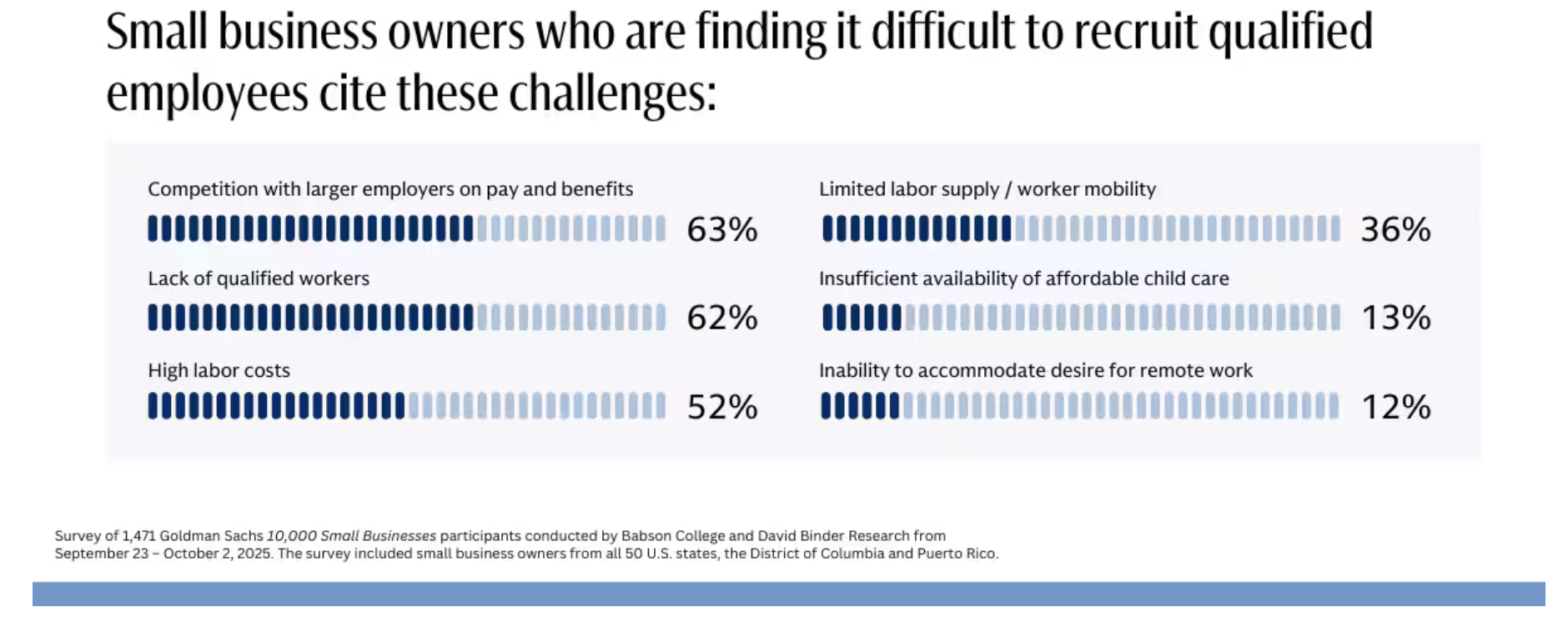
91% of small businesses that are currently hiring are finding it difficult to recruit qualified employees. Their top challenges are competition with larger employers on pay and benefits and a lack of qualified workers.
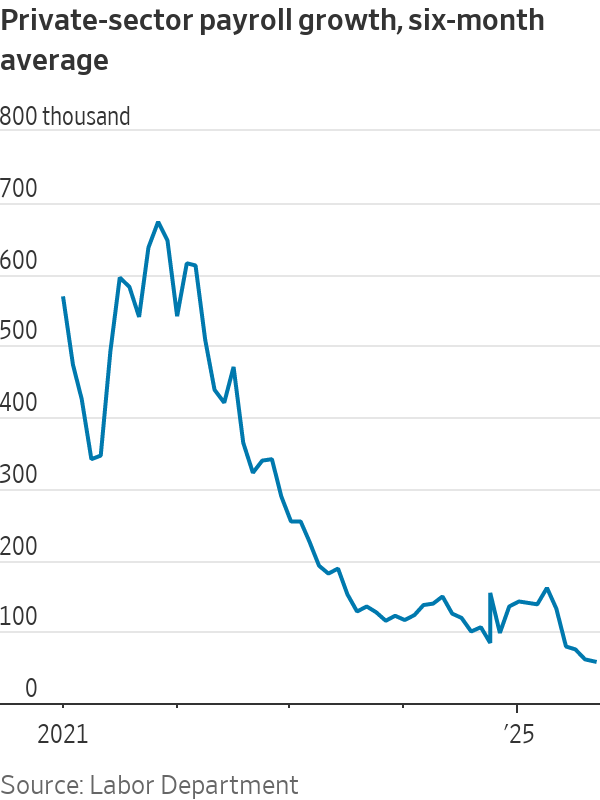
WSJ: Private-sector payroll growth using a 3-month moving average ticked up to 57,000 in September from a cycle low of 16,000 in August.
Using a longer 6-month average, private sector payrolls edged down to 58,000 in September, a new cycle low

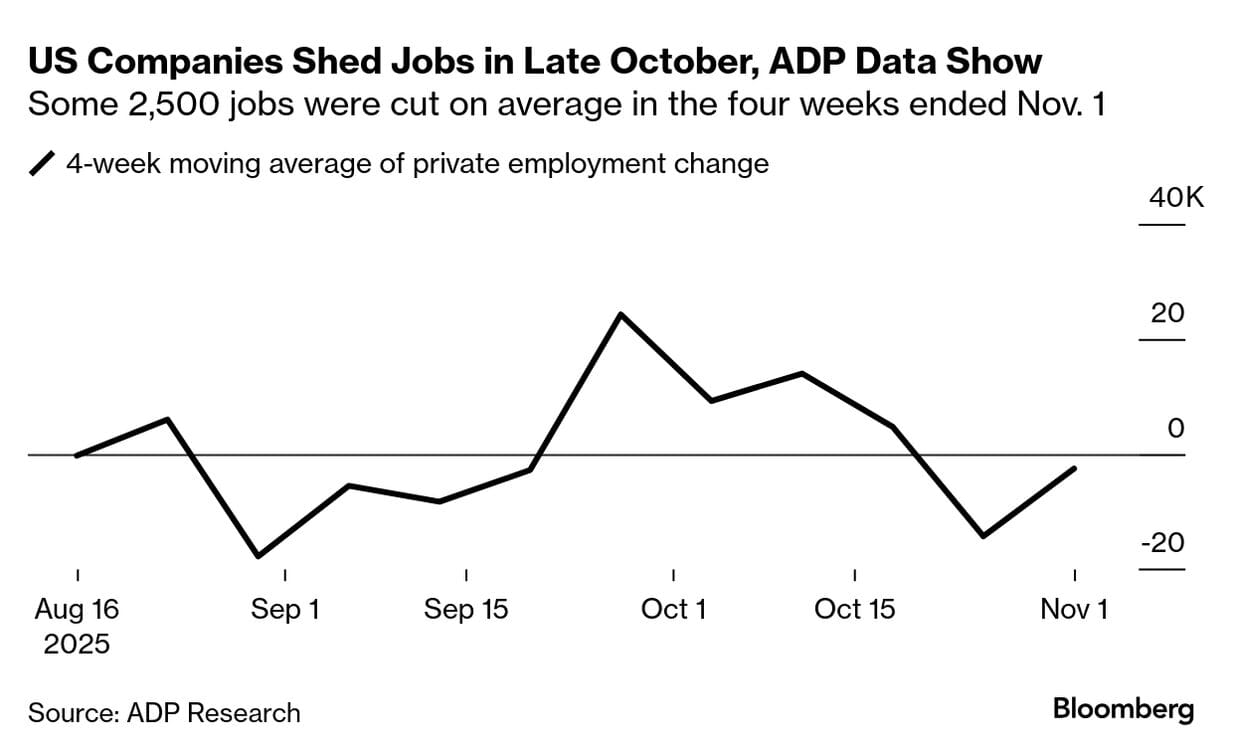
US companies shed 2,500 jobs per week on average in the four weeks ended Nov. 1, according to data released Tuesday by ADP Research. Separate data posted by the Labor Department website showed initial applications for jobless benefits totaled 232,000 in the week ended Oct. 18—roughly in line with the level of claims in mid-September.
Meanwhile, Americans have grown increasingly concerned about job security. A Harris Poll for Bloomberg News conducted on Oct. 23-25 showed 55% of employed Americans are worried about losing their job.
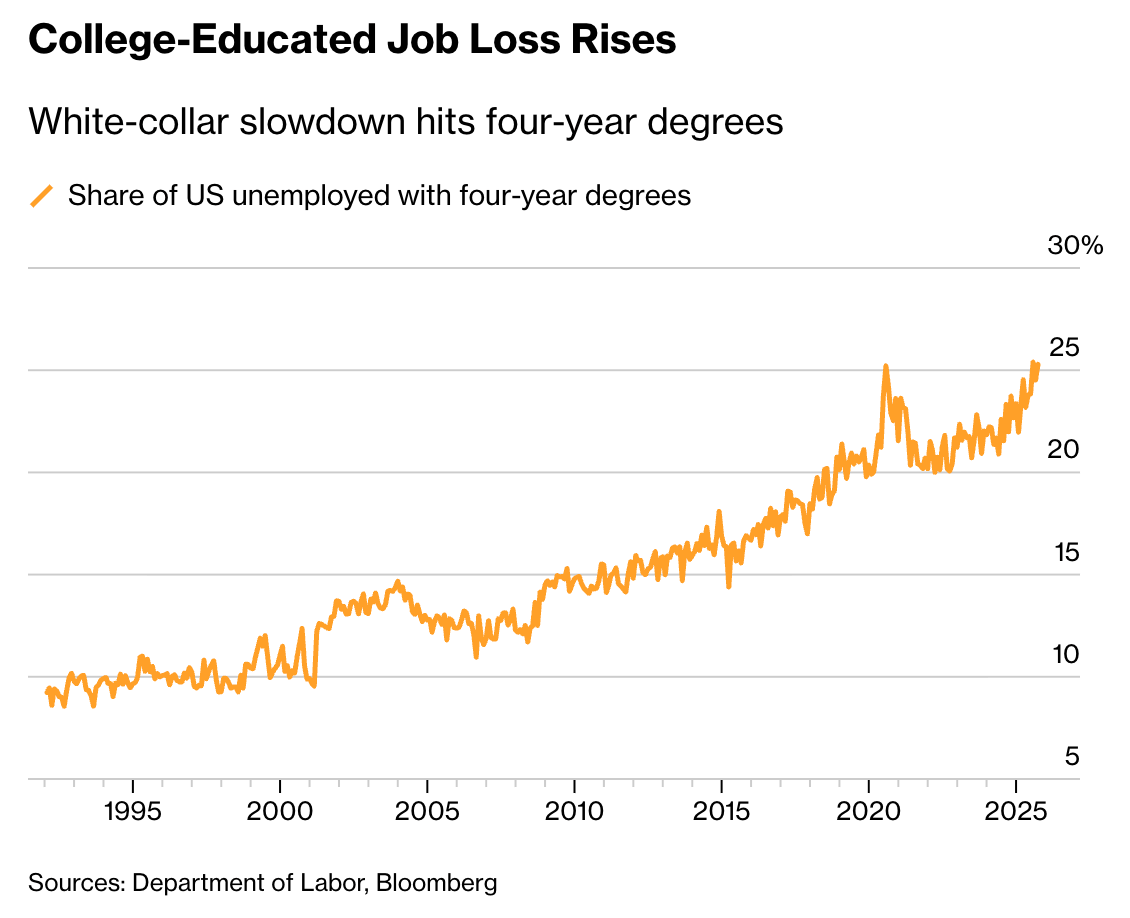
Americans with four-year college degrees now comprise a record 25% of total unemployment, underscoring a sharp slowdown in white-collar hiring this year.
There were more than 1.9 million Americans aged 25 and over with at least a bachelor’s degree who were unemployed in September — one in four of the total number of unemployed. Before 2025, the ratio never reached such a high in data going back to 1992. Younger, recent college grads have also been struggling to find work. Rising unemployment among the college-educated “should further fuel AI-related job loss fears,” Michael Feroli, the chief US economist at JPMorgan Chase & Co., said Thursday in a note following the release.
Top performers for the small bay industrial sector include Richmond, Virginia; Tampa, Florida; Nashville, Tennessee; Columbus, Ohio; Salt Lake City, Utah; and Miami, Florida.
All of the markets scored well in terms of increased leasing activity for sub-50,000-square-foot industrial tenants over the past two years, compared to pre-pandemic levels from 2015 to 2019.
In addition, these areas have also outperformed other U.S. markets in terms of rent gains for small bay properties, from the pre-pandemic period to today.
The four variables analyzed were: Leasing activity for sub-50,000-square-foot spaces in the last two years, compared to the pre-pandemic average since 2015, to assess tenant demand performance; Vacancy rate expansion for industrial properties between 10,000 to 100,000 square feet, to quantify how tight the small bay market has remained over the last few years; Inventory growth since 2015 of properties measuring 100,000 square feet or smaller, to assess the ease of building new small bay supply; and rent increases for small bay spaces from pre-pandemic average levels, to average levels seen since 2023, to assess asking rental gains.

DFW’s office market has emerged as a poster child for resilience in 2025. The region’s competitive economic development focus and growing specialization in finance have led to sustained demand even as national trends remain mixed and macroeconomic headwinds prevail.
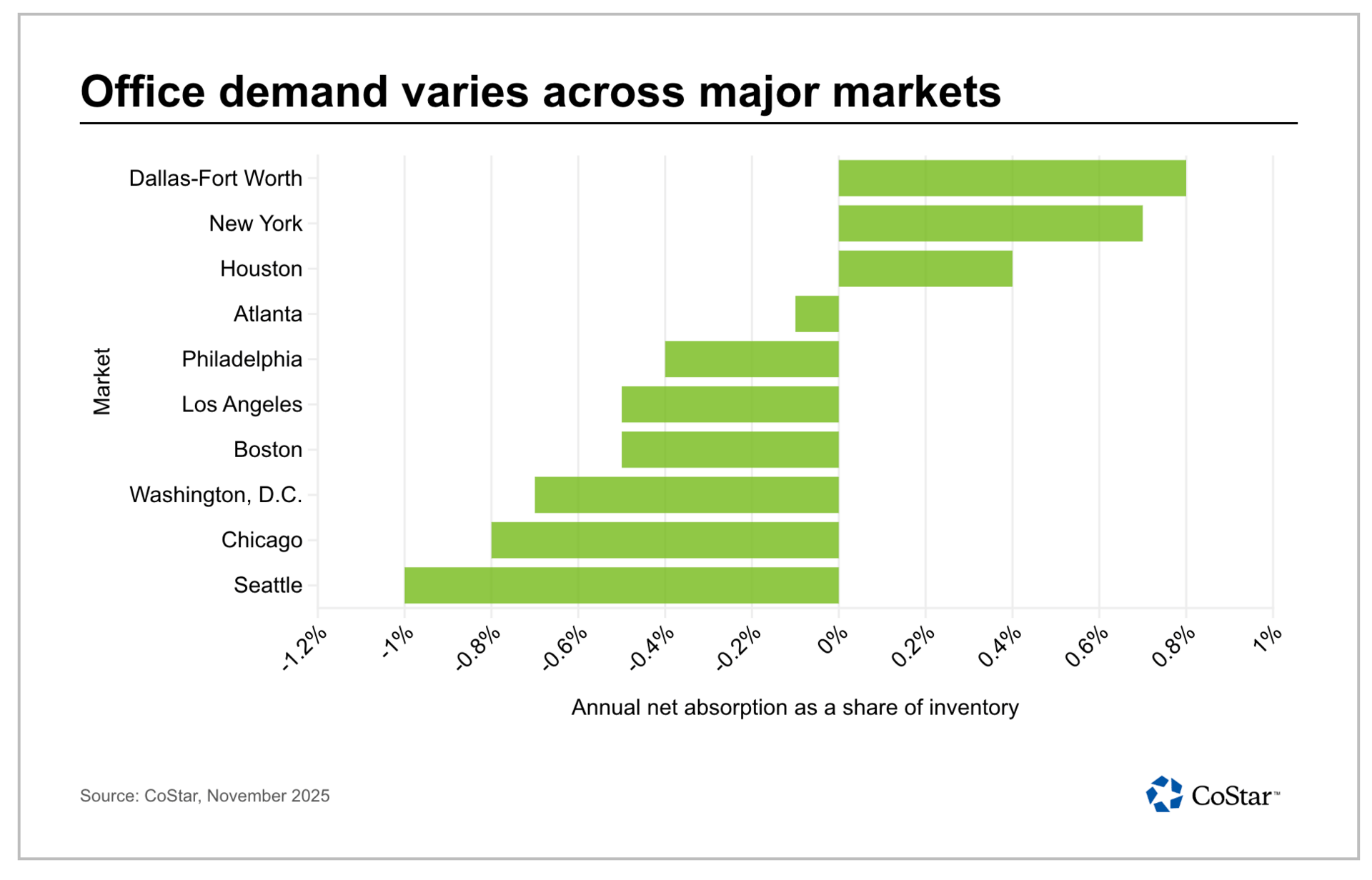
When isolating non-owner-occupied buildings over 25,000 square feet and excluding medical office, net absorption has topped 1.4 million square feet year to date.
New supply and pre-leasing led to a spike in net absorption in the third quarter. Among owner-occupied move-ins,
Wells Fargo’s two 425,000-square-foot buildings completed in Las Colinas
Pre-leasing at 23Springs contributed to roughly 250,000 square feet in net absorption when the building hit the market over the summer
Overall vacancy rate decreased 30 basis points to 17.7% in the third quarter.
Segmenting deal size, the share of new leases 50,000 square feet or greater has risen to 14% this year, up from 11% in 2024. Top deals feature Scotiabank, Toyota Financial Services, GEICO, AT&T and PennyMac

Back in April 2025, just 1.0% of U.S. mortgages were underwater, according to ICE Mortgage Technology. As of October 2025, that share has risen to 1.6%. That “underwater” uptick is primarily concentrated in three areas: VA and FHA loans, which typically involve lower down payments. Recent vintages—specifically loans originated in 2023, 2024, and 2025. Housing markets in the Southwest, Southeast, and West, where home prices have seen more notable declines since the Pandemic Housing Boom fizzled out in 2022.

Insurance now accounts for 9% of the typical U.S. homeowner’s payment—the highest share on record, according to Cotality. Several states have seen double-digit premium increases in just the past year. Looking ahead, Cotality expects average annual U.S. homeowner insurance premiums to rise another 8% in 2026, followed by an additional 8% increase in 2027.

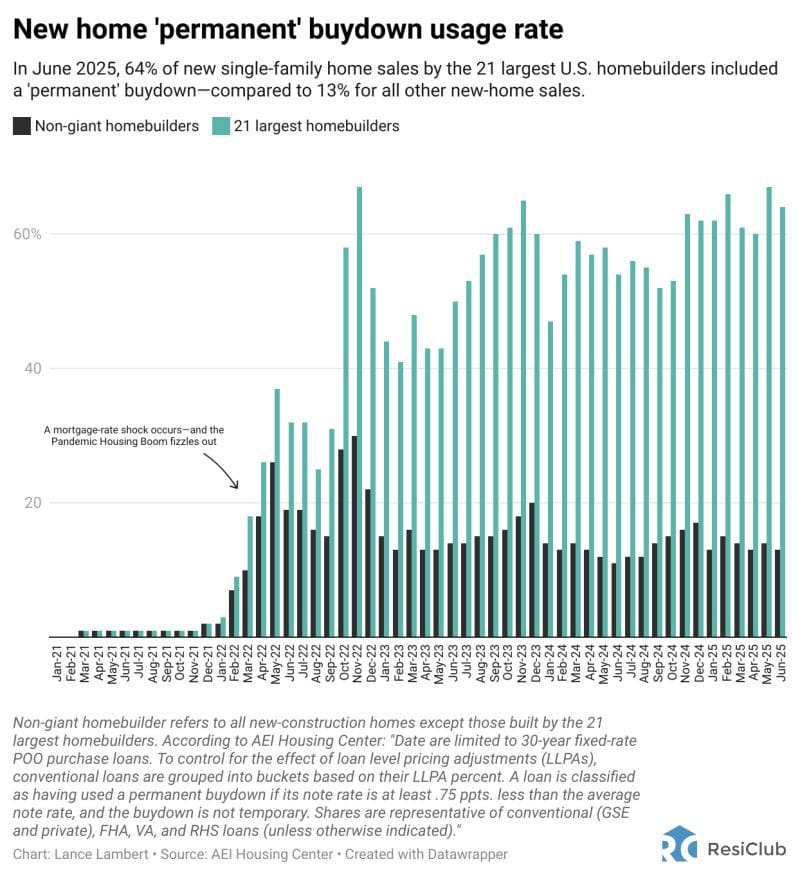
64% of new single-family home sales by the 21 largest homebuilders include a 'permanent' buydown right now
Among all other homebuilders it's 13%, according to AEI Housing Center data
After more than 3 years after breaking ground, Hines has resumed the $4 billion Riverwalk 200 acre mixed use development in Mission Valley, San Diego, CA.
Hines secured $380 million in construction financing, comprising a $278 million senior loan from Bank OZK and a $102 million mezzanine loan provided by Related Fund Management, which originated the investment through its Related Real Estate Debt Fund IV.
Riverwalk San Diego is launching at a strategically significant point in the real estate cycle. Following a period marked by uncertainty – driven by remote work and evolving demand patterns – market fundamentals now indicate a renewed appetite for high-quality, integrated communities. According to Hines Research’s “To Buy or to Build?” analysis, early-cycle development, when supported by long-term vision and strong fundamentals, presents a compelling opportunity. Riverwalk reflects this approach, serving as a benchmark for high-quality, sustainable urban development.
Phase one, designed by Gensler, will deliver 721 market-rate multifamily homes, inclusive of apartments and townhomes, across four buildings, a vibrant village green and 75,000 square feet of grocery-anchored retail. Separately, the initial phase includes The Becker—a 190-home affordable housing community in partnership with Wakeland Housing, which is already under construction – and a new trolley station on the MTS Green Line. The station’s timeline has been accelerated from a later phase thanks to a $41.1 million Affordable Housing and Sustainable Communities grant. The completion and grand opening of phase one is slated for spring 2029, with the first homes becoming available in spring 2028.
At full completion, Riverwalk San Diego will deliver:
4,300 homes (10% income-qualified affordable)
150,000 square feet of retail
One million square feet of office space
110 acres of parks and open space, including a 60-acre regional park Restoration of the San Diego River and extension of the River Trail
Flood capacity improvements to Fashion Valley Road
