- Location Strategy Chartbook
- Posts
- Location Strategy Chartbook 12.06.25
Location Strategy Chartbook 12.06.25
Real Estate Market Insights
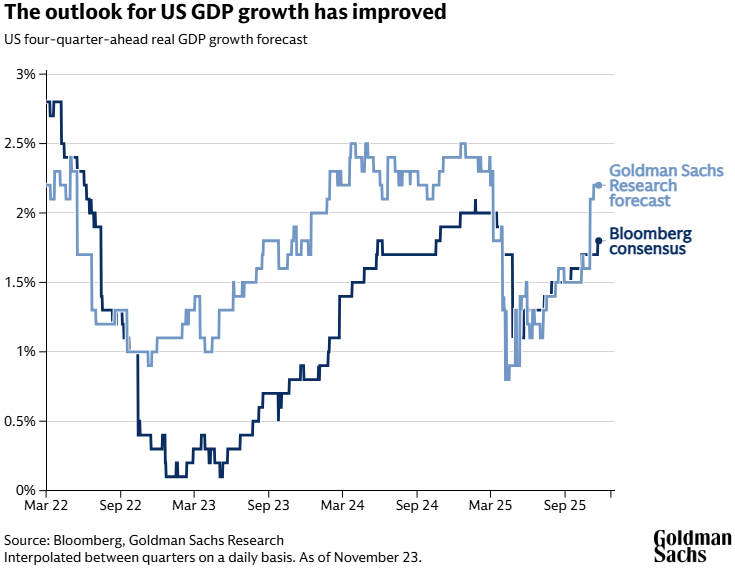
The US Federal Reserve is likely to cut rates next week after September’s delayed jobs report showed signs of a weakening labor market. While the outlook for 2026 is less clear, Jan Hatzius, Goldman Sachs Research's chief economist, expects the Fed to slow the pace of easing in the first half of next year as economic growth reaccelerates and inflation cools.

WSJ
Goldman Sachs Research forecasts US economic growth will accelerate to 2-2.5% in 2026, driven by reduced impacts from tariffs, by tax cuts, and by easier financial conditions. Hatzius expects the Fed to pause its cutting cycle in January before delivering cuts in March and June, pushing the funds rate down to a terminal level of 3-3.25% (compared with 3.75% to 4% currently).
That said, the labor market, especially for college-educated workers—who account for an estimated 55-60% of US labor income—shows signs of weakening, according to Hatzius. “A further deterioration in employment opportunities for this key demographic—perhaps reflecting artificial intelligence (AI) and other efficiency-enhancing measures—could have a disproportionate negative impact on consumer spending and prompt further rate cuts over time.”
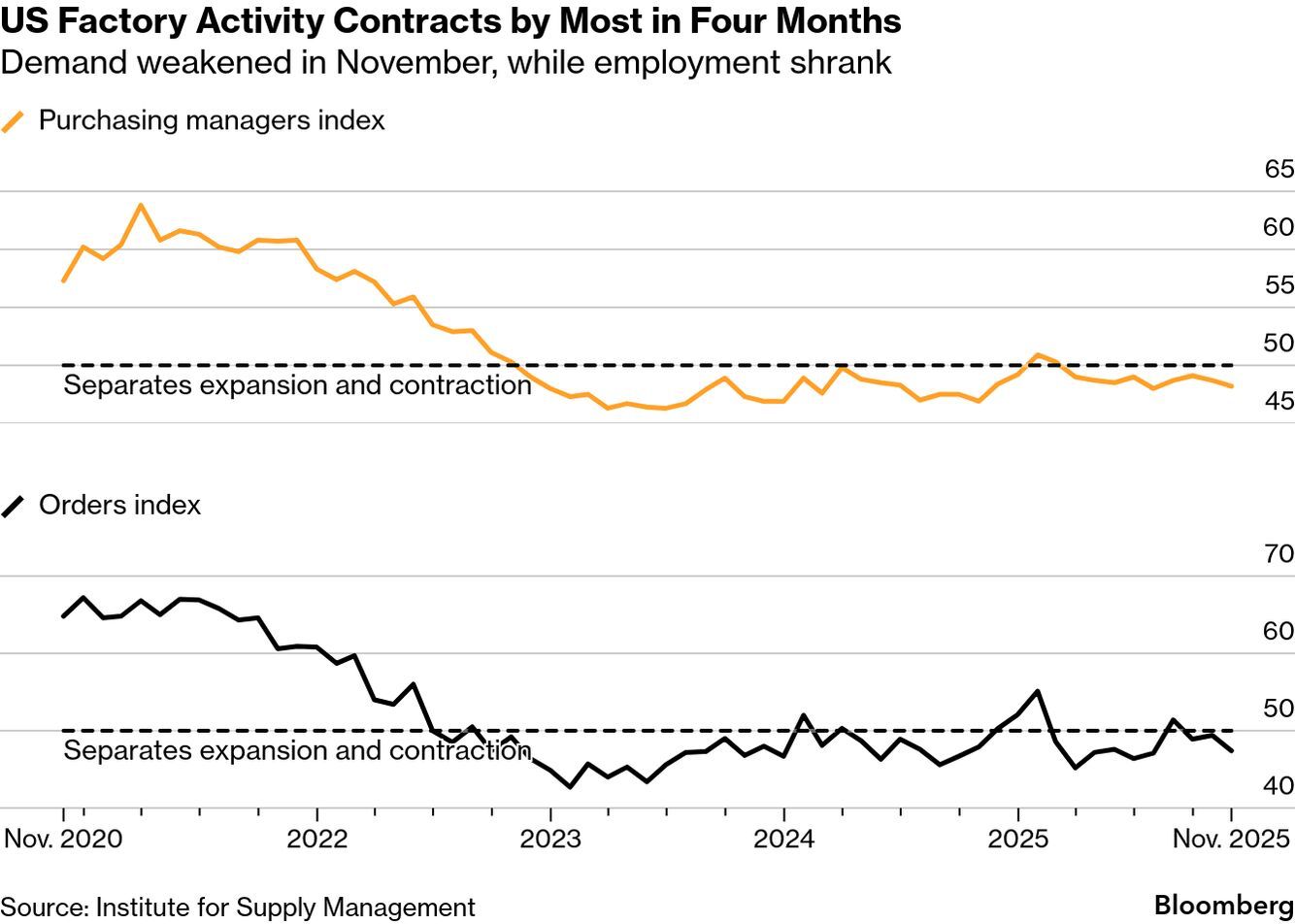
US factory activity fell in November by the most in four months as orders weakened, indicating manufacturers are struggling to break free from an extended period of malaise.
The Institute for Supply Management’s manufacturing index eased 0.5 point to 48.2, according to data released Monday. The measure has been below 50—which indicates contraction—for nine straight months.
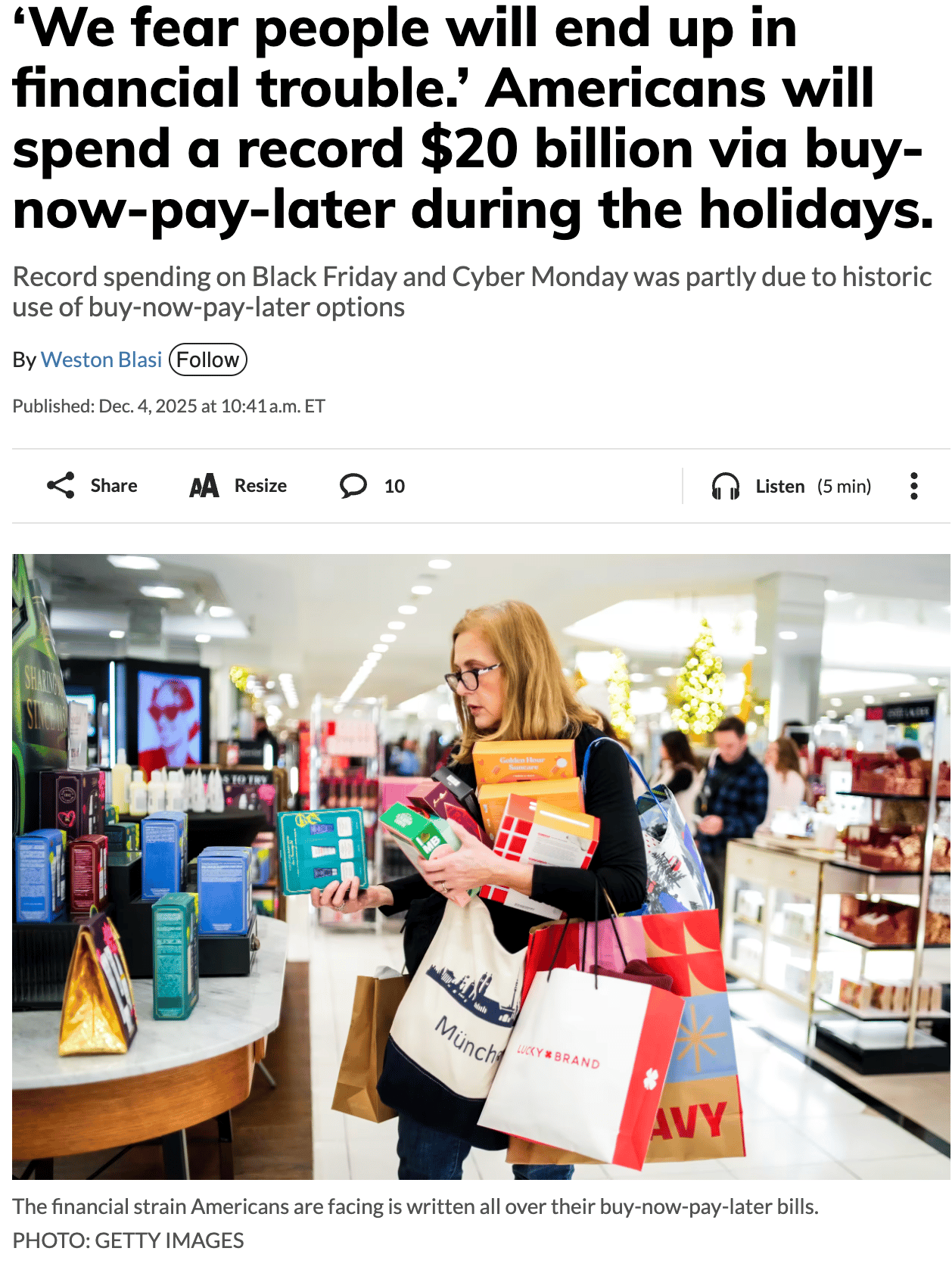
Marketwatch: Holiday spending hit an all-time-high on Black Friday and Cyber Monday — thanks in part to the number of people who used buy-now-pay-later options.
Americans spent $1.03 billion on Cyber Monday alone using buy-now-pay-later services like Klarna, Affirm and PayPal— an all-time high, according to new data from Adobe — and that figure is expected to go even higher. Over the course of the Nov. 1–Dec. 31 holiday shopping season, buy-now-pay-later is expected to facilitate $20.2 billion worth of payments, a year-over-year increase of 11%, per Adobe
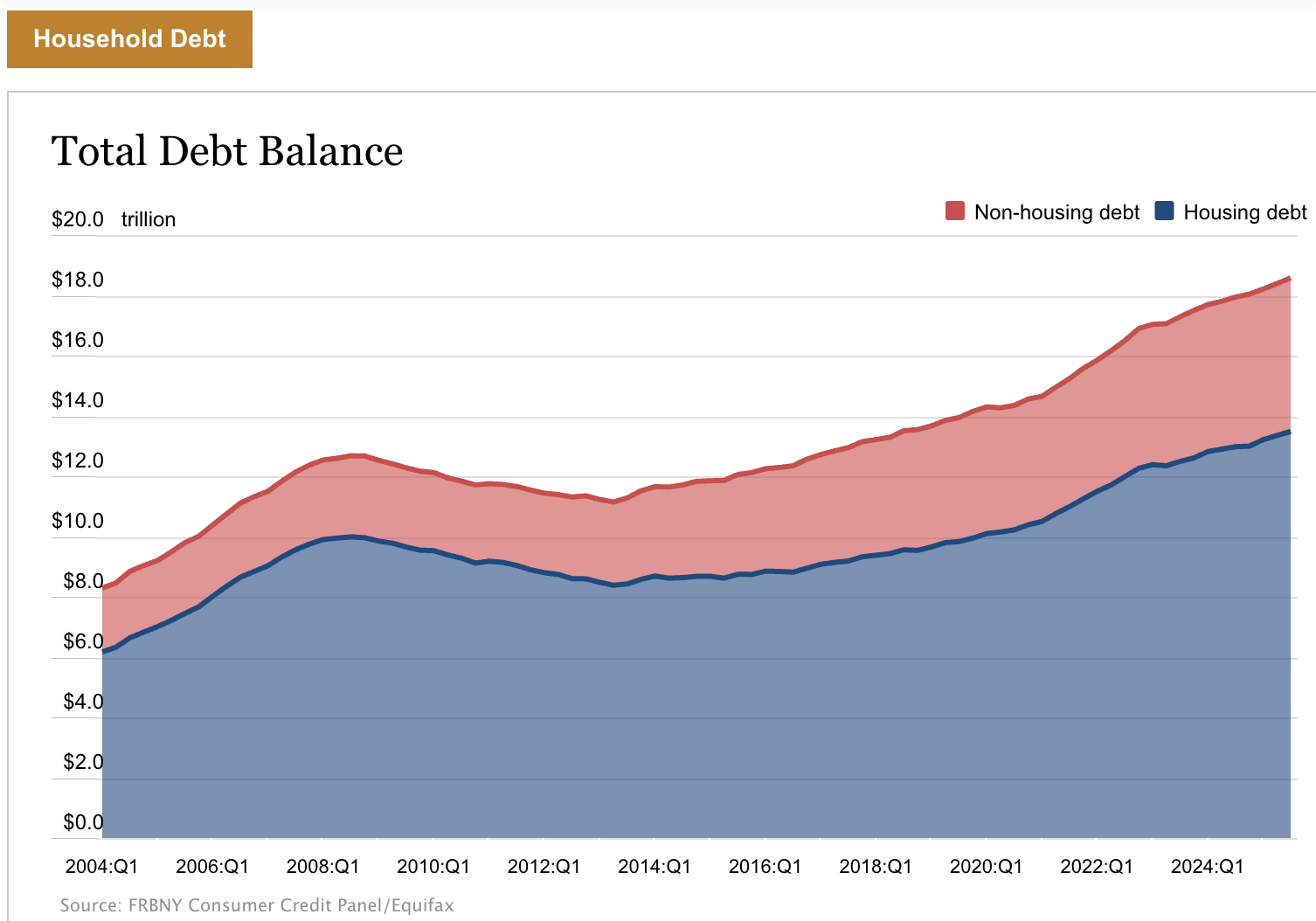
Total household debt increased by $197 billion to reach $18.59 trillion in the third quarter, according to the latest Quarterly Report on Household Debt and Credit. Mortgage balances grew by $137 billion and totaled $13.07 trillion at the end of September. The pace of mortgage originations increased, with $512 billion newly originated in the third quarter. Credit card balances rose by $24 billion from the previous quarter and stood at $1.23 trillion, while auto loan balances held steady at $1.66 trillion. HELOC balances rose by $11 billion to $422 billion, and HELOC limits rose by $8 billion, continuing the growth that began in 2022. Student loan balances rose by $15 billion and stood at $1.65 trillion.
American consumers entered the peak of the holiday shopping season offering a basket of mixed signals.
Industry group reports hinted at a positive October for retailers, and the Federal Reserve’s Beige Book suggested that while middle-income households appear to be pulling back, high-income households continued to spend.
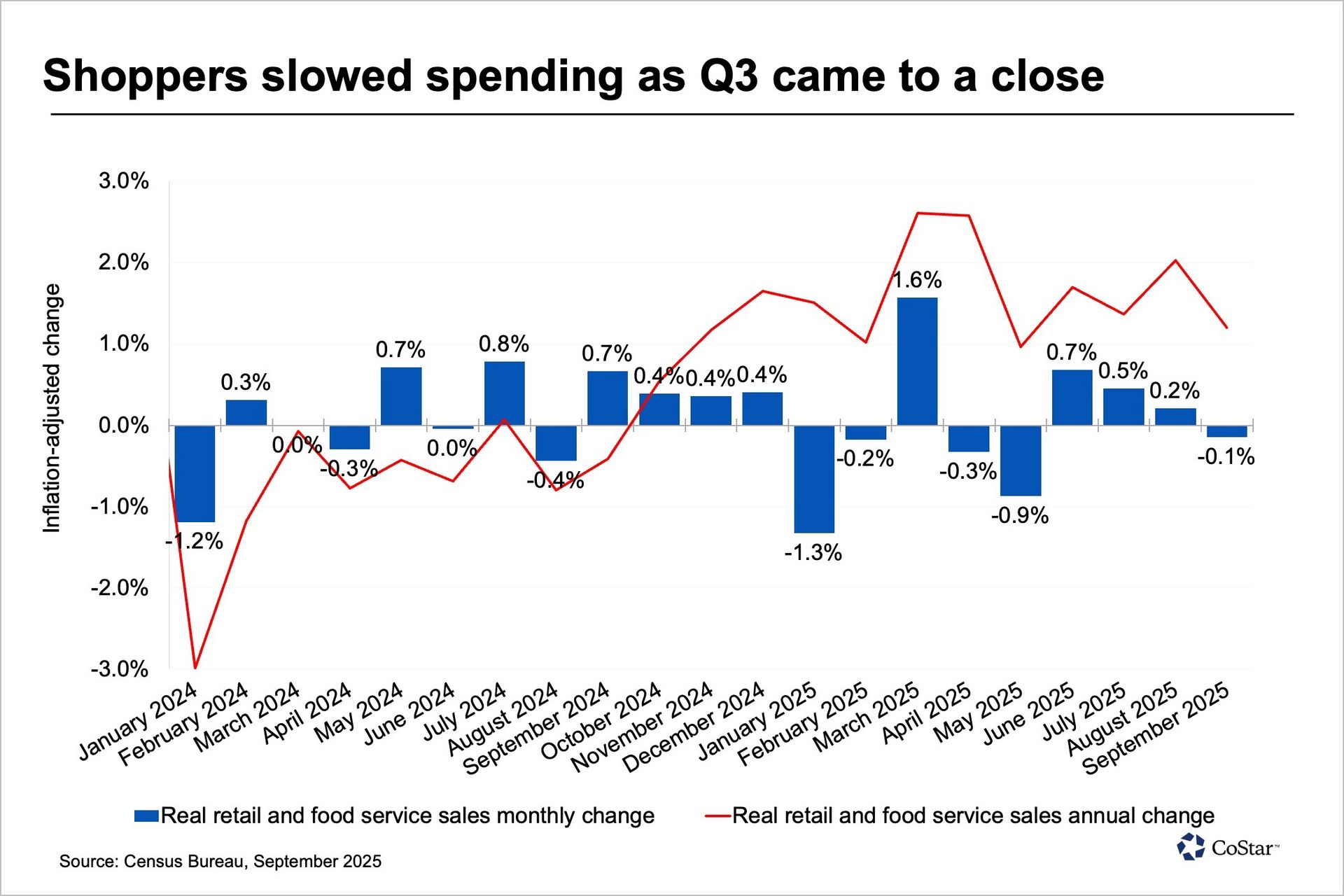
Other surveys conducted in November indicated that consumer confidence and sentiment had declined for all income groups. Meanwhile, official retail sales data from the U.S. Census Bureau, delayed due to the federal government shutdown, showed a sluggish September during which inflation-adjusted retail sales fell for the first time since May.
Put together, these anecdotes and delayed data suggest a cautious, not collapsing, consumer. Factors beyond consumer health or confidence, such as the timing of sales promotions and the front-loading of spending earlier in the year to avoid tariff-related price increases, may explain some of the decline.

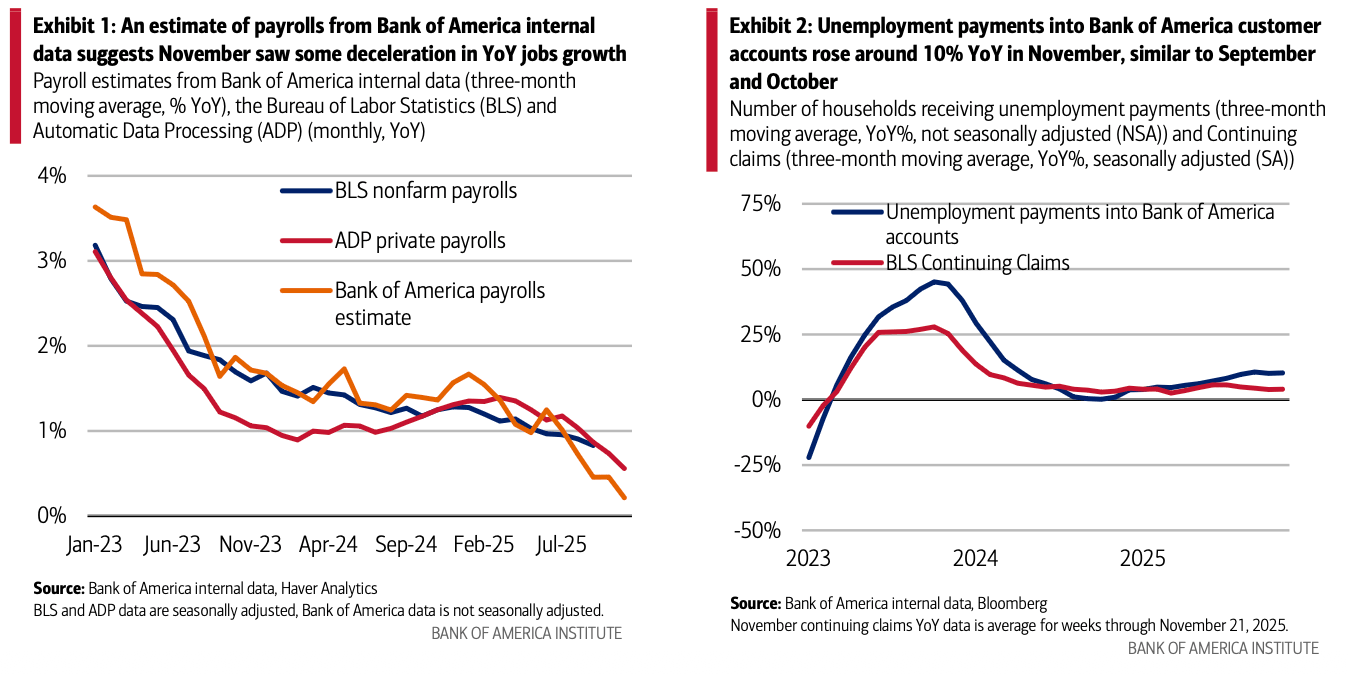
Our data suggests payroll growth slowed in November, though remained positive year-over-year (YoY). Combined with no acceleration in the rise in unemployment payments into Bank of America customer accounts, the data suggests we remain in “low-hire, low-fire” mode, in our view. We use Bank of America internal deposit data to estimate a payrolls series by looking at how the number of customer accounts receiving a paycheck is changing (see methodology). This data can be fairly noisy, partly due to seasonal variation. It is also possible that the government shutdown impacted the number of paychecks in November, but most federal employees did receive back-pay once the shutdown ended mid-month, so we think the impact should be small.
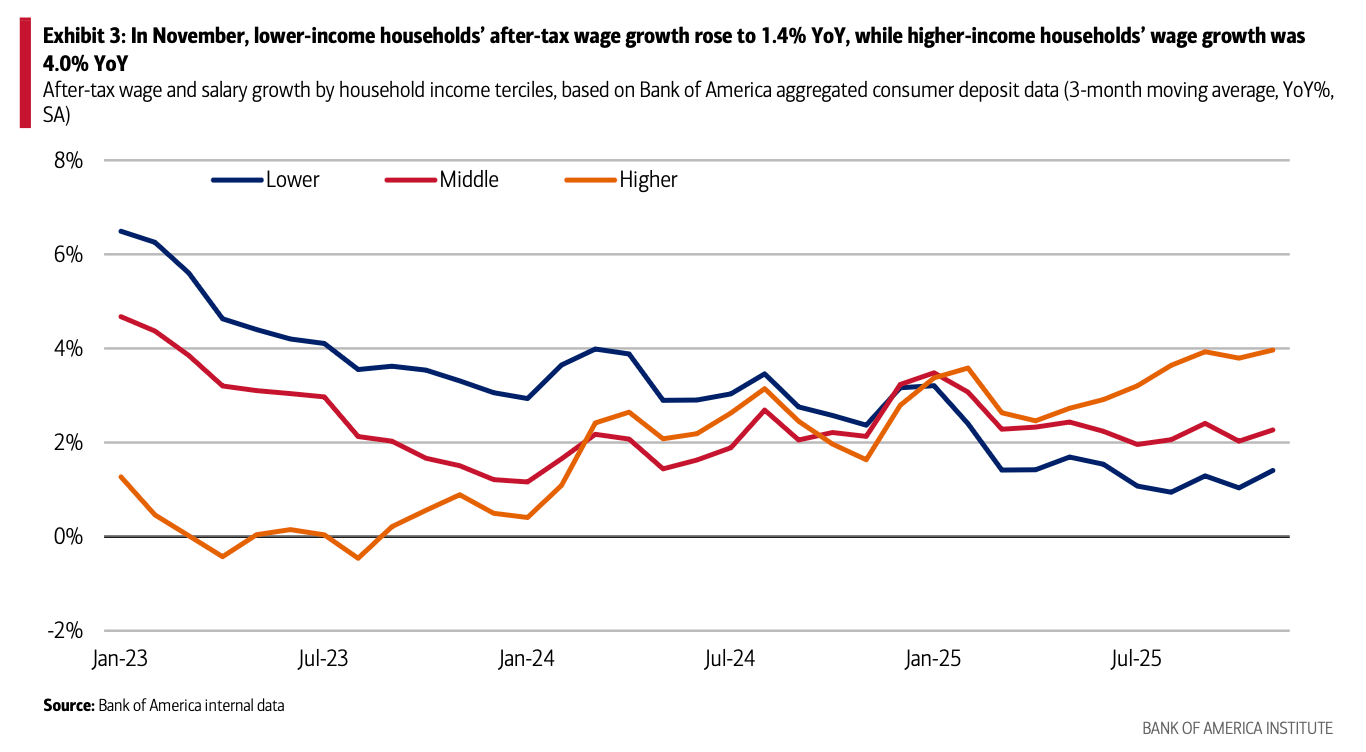
After-tax wage and salary growth rose across income cohorts in November, with higher-income households at 4.0% YoY, middle-income at 2.3% YoY, and lower-income at just 1.4% YoY.
US companies fired employees or otherwise reduced payrolls last month by the most since early 2023, further accelerating a trend of job losses that’s plagued the Trump administration for much of its second term. Unemployment currently sits at 4.4%.
Private-sector payrolls decreased in November by 32,000, according to ADP Research data released Wednesday. Payrolls have now fallen four times in the last six months. The median estimate in a Bloomberg survey of economists called for a 10,000 gain.
“Hiring has been choppy of late as employers weather cautious consumers and an uncertain macroeconomic environment,” said Nela Richardson, chief economist at ADP and a contributor to Bloomberg Television. “And while November’s slowdown was broad-based, it was led by a pullback among small businesses.”
Companies with fewer than 50 employees shed 120,000 jobs, the largest one-month decline since May 2020. Those with 50 or more employees increased headcount. Until recently, many economists have said the labor market is in a state of low hiring and low firing. But a number of large companies, including Apple and Verizon, recently undertook mass terminations or announced plans to do so, which risks driving unemployment even higher.

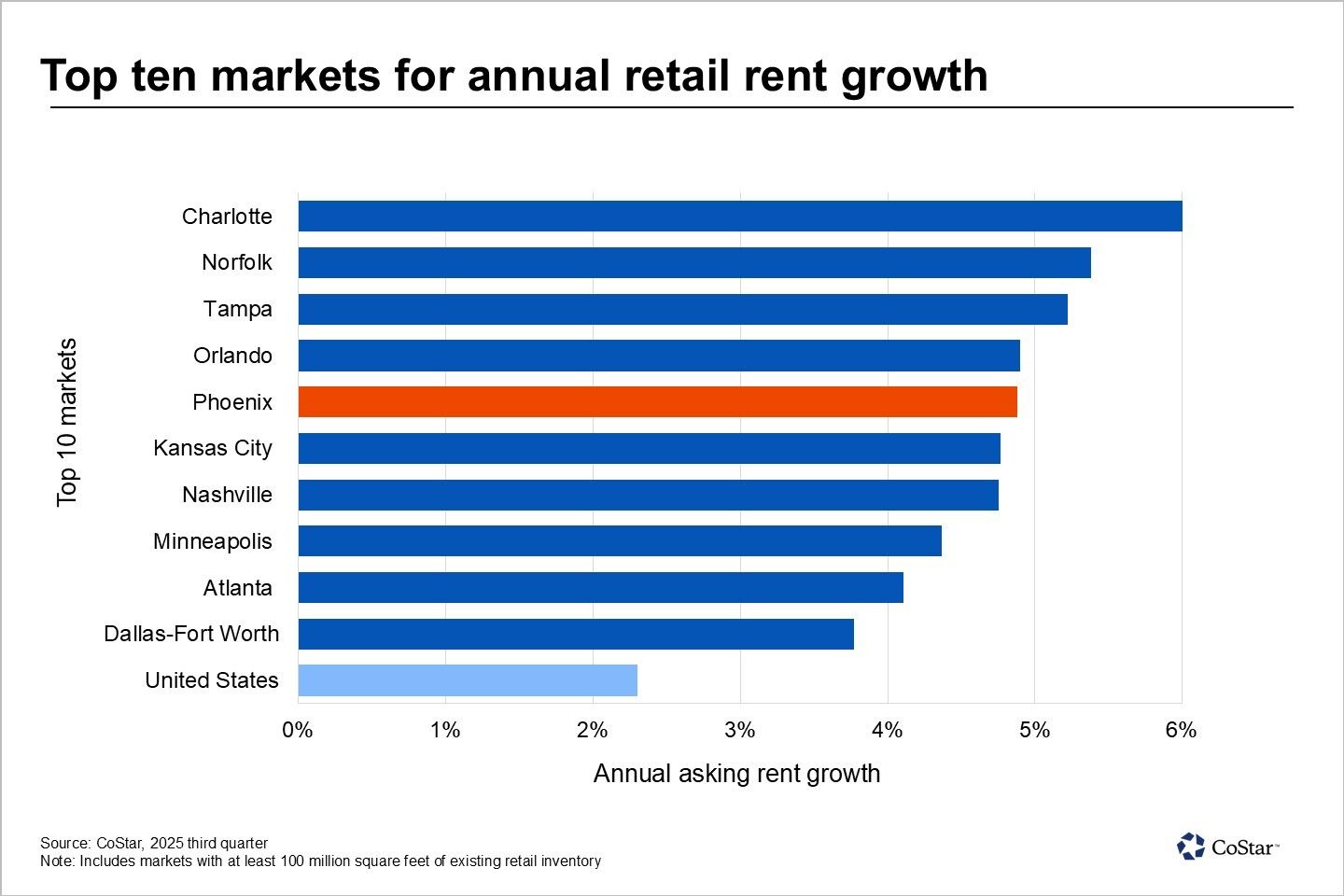
The average asking rent at Phoenix retail properties rose 4.9% annually in the third quarter of 2025, the fifth-largest gain in the United States among major retail markets.
Last quarter’s performance narrowly edged out Kansas City’s 4.8% gain and more than doubled the 2.3% increase achieved overall in the United States. It also earned Phoenix the designation as the only market from a Mountain or West Coast state to rank in the top 10.
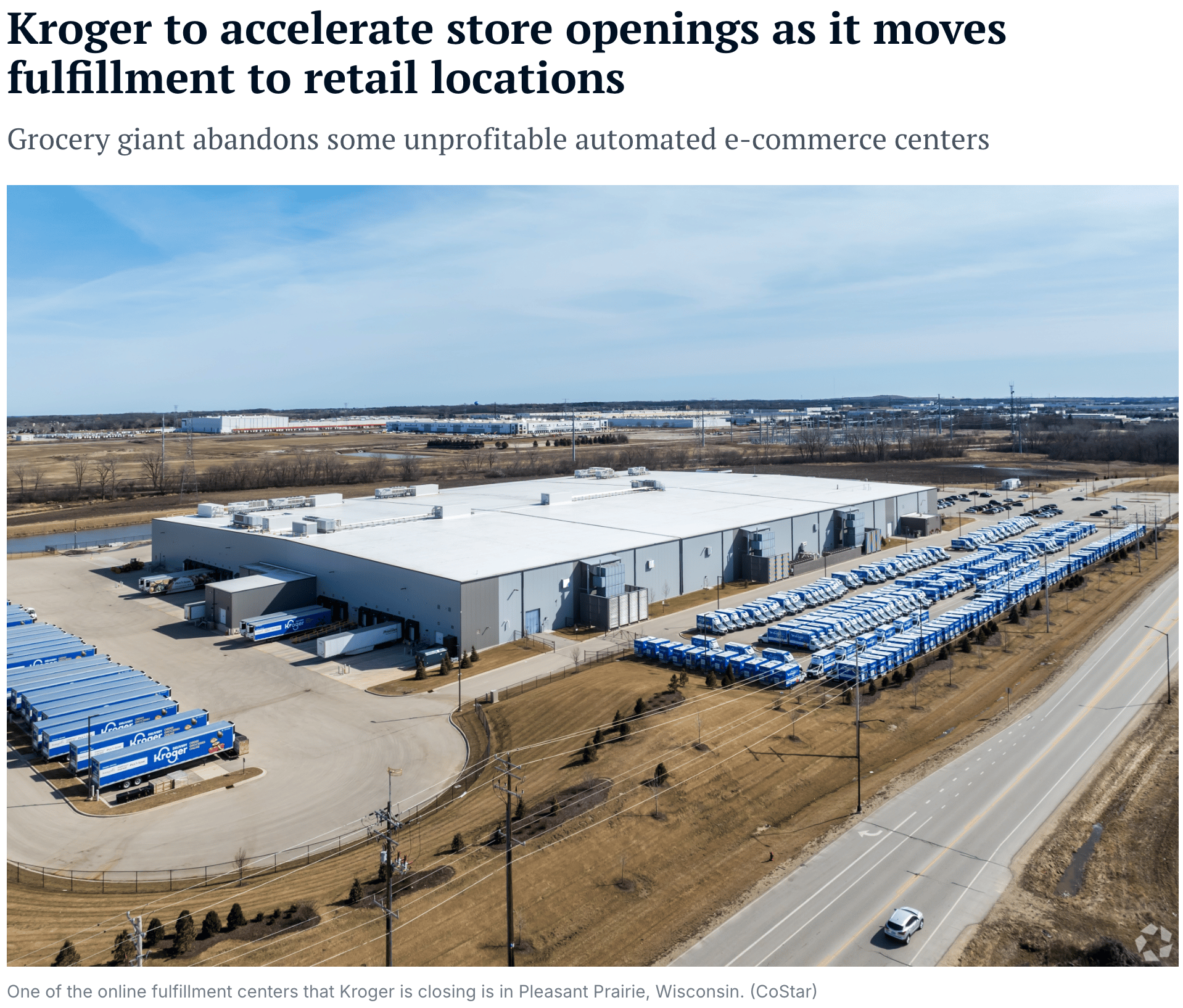
Grocery giant Kroger plans to step up store openings next year as it closes three of its e-commerce fulfillment centers and shifts order delivery to its brick-and-mortar retail locations.
Next month Kroger plans to shutter a trio of its eight automated e-commerce properties, and it will take a $2.6 billion impairment charge in the third quarter as a result.
The facilities slated to be closed are at 7925 American Way, Groveland, Florida, 375,000 square feet; 9091 88th Ave., Pleasant Prairie, Wisconsin, 330,000 square feet; and 7106 Geoffrey Way, Frederick, Maryland, 717,135 square feet.
Several years ago, with much fanfare, Kroger started opening highly automated centers across the country that use robotics and artificial intelligence to fulfill online grocery orders in a partnership with U.K. tech firm Ocado Group. The goal was to give Kroger a presence in areas where it didn't have stores, such as Florida. But the concept’s execution faced challenges.
“One of the big operational missteps has been with the Ocado partnership to build out automated warehouses,” Neil Saunders, a retail analyst and managing director of analytics firm GlobalData, said Thursday in a note. “In theory this is not a bad idea, but the decisions were predicated on a penetration of online grocery that was overhyped during the pandemic and never materialized. This ultimately means the financial basis of Kroger’s investment was flawed: The volume needed to recoup the capital costs was not there.”
And even though the Ocado model “helped reduce the cost to serve in terms of picking and packing, it never reduced the cost or time to deliver, which in the U.S. can be high because of lower population densities, especially compared to Ocado’s home market of the U.K.,” according to Saunders.
The result “of this poor thinking on Kroger’s part is that the partnership has now been terminated and has, this quarter, created a $2.6 billion impairment charge which has pushed the group to an operating loss of $1.5 billion,” he said.
On the earnings call, Sargent described Kroger’s effort to speed up the expansion of its store footprint.
“We expect to break ground on 14 new stores in the fourth quarter, marking a meaningful acceleration in activity,” he said. “And when you look at 2026, we expect to increase new-store builds by 30%.”
The new Harris Teeter stores are coming to the following locations:
Jacksonville, Florida, Atlantic Boulevard and Kernan Boulevard North. Construction of the 61,000-square-foot store is expected to start in the spring.
Clemson, South Carolina, 501 Old Greenville Highway. Construction of the 53,000-square-foot store is set for spring.
Kannapolis, North Carolina, North Main Steet and Loop Road. Construction is slated for next fall on the 53,000-square-foot store.
Lake Wylie, South Carolina, WestLake Village, State Highways 55 and 49. Construction is to start this winter on 61,000 square feet.
Fort Mill, South Carolina, Dobys Bridge Road and Fort Mill Parkway/Catawba Ridge Market. Construction is set for winter on 61,000 square feet.
Bloomberg: New York developers are transforming struggling office buildings into more than 12,000 new apartments in a bid to help offset the city’s worst housing crisis in decades. Most of the units are either starting or completing construction next year and over 3,000 of them will be earmarked as permanently affordable homes, according to a new estimate from the Adams administration which tracks progress on City of Yes — a 2024 zoning overhaul designed to spur housing development. A change in a tax-incentive last year also contributed to the growth.
Real estate developers have already turned iconic towers like Goldman Sachs Group Inc.’s former headquarters and JPMorgan Chase & Co.’s old brick fortress into luxury apartments, helping remake the Financial District into a residential neighborhood after banks moved uptown. There’s been a more recent push into midtown Manhattan, with firms lined up to convert Pfizer Inc.’s former headquarters into more than 1,500 rentals and others overhauling the Archdiocese of New York’s onetime home.
55 Broad: Goldman’s former HQ opened in 2024


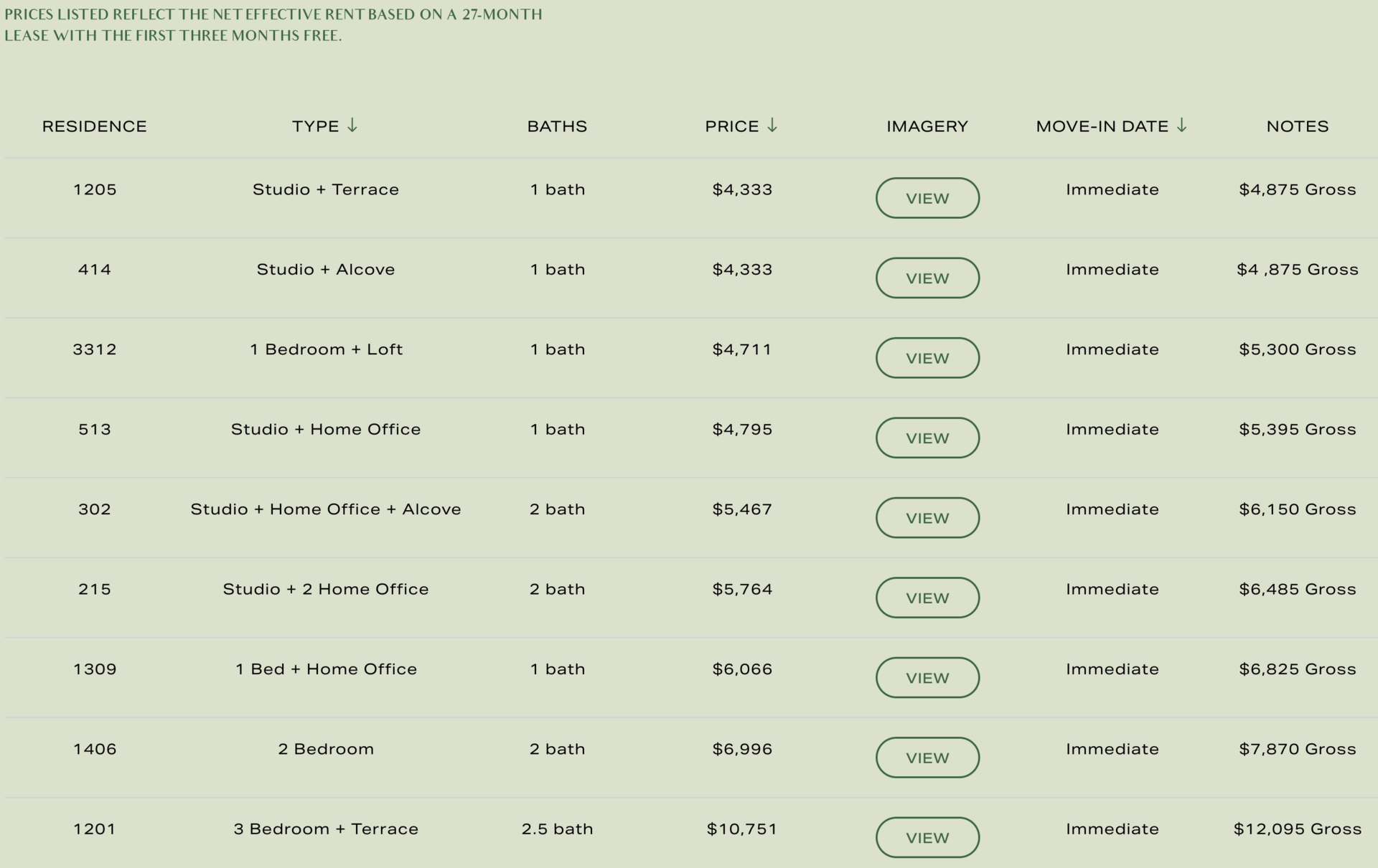



SomaNYC: JPM’s old office at 25 Water Street opened for leasing this year



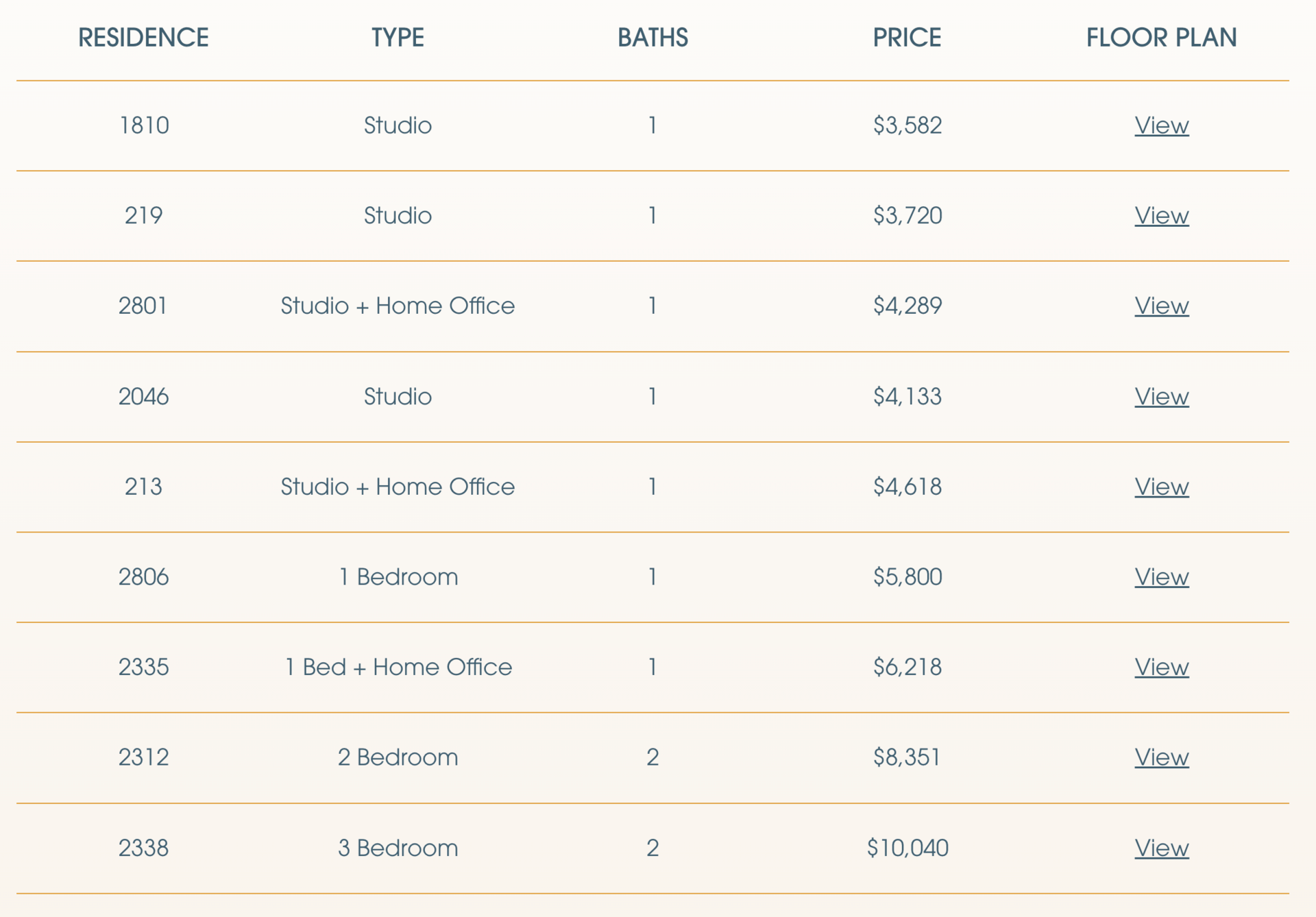
The full list of amenities is impressive